Archive for January, 2026

Symbol of Wings and Ribs

January 14, 2026

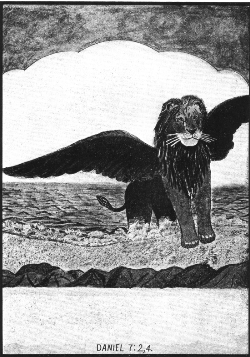
We may now inquire the meaning of the wings on the lion and on the leopard; also the ribs in the mouth of the bear.  The wings on the lion certainly cannot represent speed, as some have taught.  If wings were to represent rapidity they should have been on the bear, for Cyrus and Darius conquered old Babylon over night.  Furthermore, if wings represent speed on one beast, they must likewise represent the same on the other.  Could they represent speed on the four-headed leopard beast?  Certainly not.  A careful observation of the symbols

Shepherd’s Rod book, Vol. 2                     33

show that the leopard beast had nothing to do with Alexander’s conquest of Medo-Persia.  The leopard represents the kingdom after the conquest was accomplished.  The four heads are the four Grecian divisions after the death of Alexander; namely, “Cassander, Lysimachus, Ptolemy, and Seleucus.”

   The conflict and conquest between Medo-Persia and Grecia is brought to our attention in Daniel 8:5-7: “And as I was considering, behold, an he goat came from the west on the face of the whole earth and touched not the ground: and the goat had a notable horn between his eyes.  And he came to the ram which had two horns, which I had seen standing before the river, and ran into him in the fury of his power.  And I saw him come close unto the ram, and he was moved with choler against him, and smote the ram, and brake his two horns: and there was no power in the ram to stand before him, but he cast him down to the ground, and stamped upon him: and there was none that could deliver the ram out of his hand.”

   In Dan. 8:20, 21, Daniel was told by the angel that the he goat “is Grecia,” the ram, “Medo-Persia,” and the notable horn between his eyes, is “the first king.”  Therefore, Alexander’s swift conquest is represented by the “he goat” which touched not the ground.  If wings were to represent speed they should have been on the “he goat” and not on the leopard.  Since the truth of what has been said cannot be denied, and as the thought that has been entertained by some is contradictory to the symbols, we must look elsewhere for the application of the “wings.”  We think it is far safer and wiser as well as more reasonable for one to admit his mistake — as we mortals are apt to make many of them — rather than to become involved in contradictory interpretations of the Word of God.

   First, we must understand that Inspiration is recording by means of these symbols the entire world’s history.  Let us not forget that there was a world before the flood.  If one of us should undertake this wonderful architectural feat to devise a blue-print, or chart, of this world’s history, we certainly would take into consideration a complete account of all its parts.  God being infinite in wisdom, as well as in power, would certainly not overlook or thoughtlessly neglect in His great chart of historical events to consider His world before the flood.

   A record of a divine survey of this world’s history from creation to redemption would be of great importance at this present time.  In an age of infidelity, atheism, and hypocrisy, men who profess to be wise in secular, as well as religious matters, have lost sight of the source of true wisdom and knowledge.  “Because that, when they knew God, they glorified Him not as God, neither

Shepherd’s Rod book, Vol. 2                     34


were thankful; but became vain in their imaginations, and their foolish heart was darkened.  Professing themselves to be wise, they became fools.” (Rom. 1:21, 22.)  Even those who profess to be teachers of righteousness, have forfeited their faith in the Biblical reckoning of creation.  God having knowledge of the present deceptive denial of His holy Word, has devised a prophetic blue-print in symbols of beasts, wings, ribs, horns, heads, crowns, etc., by which He points out in this prophetic panorama, the facts, with a force that should humiliate men and show them their utter ignorance and lack of wisdom.

   According to Biblical reckoning the flood came more than 1600 years after creation.  God originated the human race through Adam and Eve.  Therefore, one people, one race, one language and nation from creation to the flood.  The rulership given to Adam we call the first universal Adamic empire.  Babylon was the second; Medo-Persia is the third; Grecia the fourth; Rome the fifth; the broken state of Rome (symbolized by the feet and toes of the great image of Daniel 2, which is the present unstable civilization) is the sixth; and from the close of the millennium after the resurrection of the wicked to their second death, is the seventh and last.  Thus the Biblical number seven, as always, signifies, completeness.  Therefore, seven such universal empires, revealing a complete history of the world, denote the end of sin and its dominion.

   If we mortals were to devise such a chart by symbols of beasts, it is certain we would have sufficient intelligence to number every beast in his regular order.  We may not suppose that God is less thoughtful in His marvelous perfection.  Therefore, He has numbered every beast.  We must first consider those which represented the Old Testament time, by the great metallic image; namely, the Gold — Babylon; the silver — Medo-Persia; the brass — Grecia.  Gold is the chief of metals which would stand as number one; silver is second to gold, therefore number two; brass is third to gold, meaning number three.  The lion, the bear, and the leopard are numbered in like manner.  The lion is king or chief of beasts, therefore number one, corresponding with the gold.  The bear is second to a lion, therefore number two, corresponding with silver.  The leopard is third to a lion, hence number three, corresponding with the brass.  These are the first set of numbers, but there is yet another set of which we must speak.

   These would bring us back to our subject of what is the meaning of the wings on the lion as well as on the leopard, and the ribs in the mouth of the bear.  God certainly would not have mapped out the world’s history, from the flood to the end, and

Shepherd’s Rod book, Vol. 2                     41

failed to take into account all its parts.  There must be something in this chart of historical events to indicate that He had a universal empire before the flood, as previously explained.  That empire being the first, naturally stands as number one; Babylon number two; Medo-Persia, number three; and Grecia, number four.  If this claim is correct, we must find this set of numbers on the lion, bear and leopard.

   The wings on the lion denote empire number two.  The lion by nature is first — first from the flood but (unnaturally) by two wings, second from creation.  The ribs in the mouth of the bear signify empire number three.  The bear by nature is second from the flood, but (unnaturally), by three ribs he is third from creation; ribs are used, for wings go in pairs.  The four wings on the leopard denote that Grecia is the fourth universal empire.  The leopard by nature is third from the flood, but (unnaturally), by the wings, fourth from creation.  History flies, therefore wings make a perfect symbol.


(To be continued)
The Sanctuary is God’s temporary Throne Room

January 3, 2026

“We have also a more sure word of prophecy ” says the apostle Peter; “whereunto ye do well that ye take heed, as unto a light that shineth in a dark place, until the day dawn, and the day star arise in your hearts: knowing this first, that no prophecy of the scripture is of any private interpretation. For the prophecy came not in old time by the will of man: but holy men of God spake as they were moved by the Holy Ghost.” 2 Pet. 1:19-21.

Tract 3                            12

   The wise reader, therefore, will henceforth cease giving place to human theories and speculations which tempt him to the uttermost to make flesh his arm. He will instead attend diligently to Bible prophecy and to inspired interpretations and will learn therefrom that the sanctuary is

God’s Temporary Throne Room.

   Since earthly beings, themselves having never been in heaven, are naturally strangers to heaven’s realities (1 Cor. 2:9), then in order for God to make heavenly truth known unto them, He must reveal it by means of earthly realities with which they are familiar. Hence through the sanctuary work on earth is seen the sanctuary work in heaven (Heb. 9:1-9). Indeed, the sanctuary above being the pattern of the one below the services of the former are therefore definitely revealed in the services of the latter. And the fact that the earthly sanctuary was appointed as a place for confession and for forgiveness of sins, shows that the throne-room in the heavenly sanctuary is only temporary. From it, while sin exists, the Lord carries on the work of removing from the universe sin and sinners. And this light in turn clearly shows that not until after sin came into the universe could the sanctuary congruously have existed in heaven.

   “I looked,” exclaimed the Revelator about 96 A.D., upon being shown the throne in the sanctuary, “and behold, a

Tract 3                            13

door was opened in heaven: and the first voice which I heard was as it were of a trumpet talking with me; which said, Come up hither, and I will shew thee things which must be hereafter.

   “And immediately I was in the Spirit, and, behold, a throne was set in heaven, and One sat on the throne. And He that sat was to look upon like a jasper and a sardine stone: and there was a rainbow round about the throne, in sight like unto an emerald. And round about the throne were four and twenty seats: and upon the seats I saw four and twenty elders sitting, clothed in white raiment; and they had on their heads crowns of gold. And out of the throne proceeded lightnings and thunderings and voices: and there were seven lamps of fire burning before the throne, which are the seven Spirits of God. And before the throne there was a sea of glass like unto crystal: and in the midst of the throne, and round about the throne, were four beasts full of eyes before and behind.”

   “And I beheld, and, lo, in the midst of the throne and of the four beasts, and in the midst of the elders, stood a Lamb as it had been slain, having seven horns and seven eyes, which are the seven Spirits of God sent forth into all the earth….And I beheld, and I heard the voice of many angels round about the throne and the beasts and the elders: and the number of them was ten thousand times ten thousand,

Tract 3                            14

and thousands of thousands.” Rev. 4:1-6; 5:6,

   Here is brought to view a twofold scene.  On the one hand, before the throne are the “seven lamps burning” and the “Lamb as it had been slain,” showing that the throne was “set” there to serve in time of probation. The light from the candlestick represents the light of truth in the church while the blood of the Lamb is atoning for sinful beings. On the other hand, upon the throne sits the Ancient of days, the Judge, surrounded by the jury of twenty-four elders plus the angelic witnesses, “ten thousand times ten thousand, and thousands of thousands” of them, plus the four beasts (who, being “redeemed” “out of every kindred, and tongue, and people, and nation” — Rev. 5:8, 9, — are therefore symbolical of the saints,– all those whose sins will be blotted from the books of records, — just as the beasts of Daniel 7 are symbolical of all the kingdoms which will perish in their sins), with the Lamb, our Advocate, in the midst. All this shows a combined mediatorial-judicial work.

   Now so far, we see that when John in vision beheld the door — the veil — as it opened to the Most Holy apartment of the heavenly sanctuary, he was permitted to look within, and that the things which he saw, were to take place “hereafter” from his time; showing thereby that at the time of his vision (about 96 A.D.) the Most

Tract 3                            15

Holy apartment was closed. In addition to this, we shall now see from Daniel’s prophecy that the judgment throne was set up in the Most Holy apartment of the heavenly sanctuary after the “little horn” of Daniel 7 came up.

   “I considered the horns,” says the seer, “and, behold, there came up among them another little horn, before whom there were three of the first homs plucked up by the roots: and, behold, in this horn were eyes like the eyes of man, and a mouth speaking great things. I beheld till the thrones were cast down, and the Ancient of days did sit Whose garment was white as snow, and the hair of His head like the pure wool: His throne was like the fiery flame, and His wheels as burning fire. A fiery stream issued and came forth from before Him: thousand thousands ministered unto Him and ten thousand times ten thousand stood before Him: the judgment was set, and the books were opened.” Dan. 7:8-10.

   These verses reveal that after “the judgment was set, and the books were opened,” “the Son of man,” Christ, was then “brought” to a position, not at “the right hand of God,” “the Ancient of days,” but “near before” Him (Dan. 7:8-10, 13).

   Both John’s and Daniel’s visions reveal that the throne in the sanctuary was not there from the beginning of the creation of God; or from the days of Moses; or yet from the hour that Christ ascended on

Tract 3                            16

high; or even from the days of pagan Rome; that, indeed, it was not “set up” until after the fall of pagan Rome, when the “little horn” of the non-descript beast came up — in the days of Ecclesiastical Rome (Dan. 7:7-12, 21, 22). Elsewhere than in the sanctuary, therefore, is

God’s Eternal Throne Room.

   Because the sanctuary throne was not in existence in the days of the early Christian church, therefore the throne upon which Stephen saw Christ at the “right hand of God” (Acts 7:56) could not have been in the sanctuary, wherein is the “sea of glass,” but rather in Paradise, whence flows the “river of water of life,” and on either side of which is “the tree of life.” Rev. 22:1, 2. Very obviously, therefore, the throne which Stephen saw is “the throne of God and of the Lamb,” the throne permanent and eternal. Round about this glory-seat are no beasts, no witnesses, no jury, and before it is “no candle,” and no blood to be offered. In short, it stands, not in the sin-laden sanctuary, but in Paradise. It is the sovereign administrative throne, from which the Infinite eternally governs His immortal sinless beings!

   To this throne, then, which is from everlasting to everlasting, Christ ascended and thereat sat down at the right hand of His Father until the time came when, in fulfillment of Daniel’s prophecy and of John’s revelation, sometime after the little-horn

Tract 3                            17

power came into existence, both He and His Father moved to the sanctuary throne. Upon the latter He does not sit as a king at the right hand of God; but rather before it does He stand both as a sacrificial lamb (Rev. 5:6), and as an intercessor (Dan. 7:13) pleading for sinful human beings. Hence, His mediatorial work began

First In The Holy, Then In The Most Holy.

   In the earthly sanctuary the high priest (typifying Christ) officiated first in the holy apartment throughout the year, then upon the day of Atonement, the day of cleansing the sanctuary and judging the people, he officiated in the Most Holy for one day only. This twofold service signifies that in the heavenly sanctuary, the High priest, Christ, must necessarily first officiate in the holy apartment up to the antitypical day of Atonement, then during that day, He must officiate in the Most Holy apartment, before the throne. Thus the earthly services, too, repudiate the idea that Christ entered the Most Holy apartment of the heavenly sanctuary immediately after His ascension.

   Very plainly, then, the ceremonial system reveals that from the time Christ “sat on the right hand of God” (Mark 16:19), where the “river of water of life” is, to the time that He and the Father moved to the throne in the sanctuary, where “the sea of glass” is (Dan. 7:9, 10; Rev. 4.6), He

Tract 3                            18

officiated in our behalf as a high priest in “the holy place” (Heb. 9:12); and that at the same time, conjointly with the Father, on the eternal sovereign throne (“the throne of God and of the Lamb”), He ruled the sinless universe.” (Tract 3, Judgment and the Harvest)