Posts Tagged ‘god’

What One Shepherd will Accomplish

May 1, 2026

TEXT FOR PRAYER Why Jesus Taught In Parables

   I shall read from “Christ’s Object Lessons,” p. 22, the first paragraph:

   “And He had another reason for teaching in parables.  Among the multitudes that gathered about Him, there were priests and rabbis, scribes and elders, Herodians and rulers, world-loving, bigoted, ambitious men, who desired above all things to find some accusation against Him.  Their spies followed His steps day after day, to catch from His lips something that would cause His condemnation, and forever silence the One who seemed to draw the world after Him.  The Saviour understood the character of these men, and He presented truth in such a way that they could find nothing by which to bring His case before the Sanhedrin.  In parables He rebuked the hypocrisy and wicked works of those who occupied high positions, and in figurative language clothed truth of so cutting a character that had it been spoken in direct denunciation, they would not have listened to His words, and would speedily have put an end to His ministry.  But while He evaded the spies, He made truth so clear that error was manifested, and the honest in heart were profited by His lessons….”

   Let us kneel and pray that we might be on guard against becoming impervious to the Truth as were the Pharisees, that we might be honest hearted and profit by the Truth that comes to us.

Timely Greetings, Vol. 2, No. 2 13ONE SHEPHERD TO ACCOMPLISH WHAT A MULTITUDE OF THEM FAILED TO ACCOMPLISHTEXT OF ADDRESS BY V.T. HOUTEFF,MINISTER OF DAVIDIAN 7TH-DAY ADVENTISTSSABBATH, AUGUST 16, 1947MT. CARMEL CHAPELWACO, TEXAS

   Let us turn to Ezekiel 34, the chapter we are to study today.

Ezek. 34:1, 2 — “And the word of the Lord came unto me, saying, Son of man, prophesy against the shepherds of Israel, prophesy, and say unto them, Thus saith the Lord God unto the shepherds; Woe be to the shepherds of Israel that do feed themselves!  should not the shepherds feed the flocks?”

   Ezekiel, we read, was given a vision of selfish, greedy, and unworthy shepherds.  Now the first thing of importance is to ascertain whether these selfish shepherds lived in Ezekiel’s day, before his day, or after his day.  To find this information, let us read–

Ezek. 34:23, 24 — “And I will set up one shepherd over them, and he shall feed them, even My servant David; he shall feed them, and he shall be their shepherd.  And I the Lord will be their God, and My servant David a prince among them; I the Lord have spoken it.”

   The self-centered shepherds against whom the prophet is told to write, are to be replaced by one shepherd, David.  When this takes place God’s people

Timely Greetings, Vol. 2, No. 2 14

will then have but one shepherd.  This, of course, cannot be Christ Himself, for Inspiration never calls Him David, but rather It calls Him the Son of David.  Since God’s people have always had, and still do have many shepherds, the truth stands out as clear as crystal that the David of verses 23 and 24 is yet to come, and that the shepherds whom Inspiration addresses are in particular those whom David is to succeed.

   Ezekiel, then, was not given a vision of the shepherds in his day, nor of those before his day, but of the shepherds after his day — the day in which God raises up this antitypical David to feed His hungry and neglected flock.  God’s people shall then no longer serve strangers, “But they shall serve the Lord their God, and David their king, whom I will raise up unto them.” Jer. 30:9.  Here we see that not only Ezekiel, but Jeremiah also was given a vision of this same truth.  Yes, all the prophets.

Ezek. 37:24, 25 — “And David My servant shall be king over them; and they all shall have one shepherd: they shall also walk in My judgments, and observe My statutes, and do them.  And they shall dwell in the land that I have given unto Jacob My servant, wherein your fathers have dwelt; and they shall dwell therein, even they, and their children, and their children’s children for ever: and My servant David shall be their prince for ever.”

   Since this is the addition to the “Third Angel’s Message” (“Early Writings,” p. 277) and since it is the message of the hour, consequently the day of the Davidian Kingdom is at hand.  Let us turn to–

Hos. 3:4, 5 — “For the children of Israel shall abide many

Timely Greetings, Vol. 2, No. 2 15

days without a king, and without a prince, and without a sacrifice, and without an image, and without an ephod, and without teraphim: afterward shall the children of Israel return, and seek the Lord their God, and David their king; and shall fear the Lord and his goodness in the latter days.”

   The many days are now almost over and the time for the fulfillment of God’s promises is certainly at the threshold of our time.

Ezek. 34:3 — “Ye eat the fat, and ye clothe you with the wool, ye kill them that are fed: but ye feed not the flock.”

   The shepherds in the day the Kingdom is to be set up are accused of taking all they can possibly take from the sheep, and of not giving any care to the sheep.  This must not become our practice.

Ezek. 34:4, 5 — “The diseased have ye not strengthened, neither have ye healed that which was sick, neither have ye bound up that which was broken, neither have ye brought again that which was driven away, neither have ye sought that which was lost; but with force and with cruelty have ye ruled them.  And they were scattered, because there is no shepherd: and they became meat to all the beasts of the field, when they were scattered.”

   This careless attitude on the part of the shepherds is causing the laity to wander from one ism to another in search of spiritual food and physical care.  Yes, they wander, so to speak, from one hill to another, many of whom have figuratively become meat for beasts (isms) because there is no shepherd to care for the sheep, but there are shearers to take the wool

Timely Greetings, Vol. 2, No. 2 16

from their backs, and the fat from under their ribs.  Shameful, indeed!  And who dare refuse to declare what God says?

Ezek. 34:6-10 — “My sheep wandered through all the mountains, and upon every high hill: yea, My flock was scattered upon all the face of the earth, and none did search or seek after them.  Therefore, ye shepherds, hear the Word of the Lord; As I live, saith the Lord God, surely because My flock became a prey, and My flock became meat to every beast of the field, because there was no shepherd, neither did My shepherds search for My flock, but the shepherds fed themselves, and fed not My flock; therefore, O ye shepherds, hear the Word of the Lord; Thus saith the Lord God; Behold, I am against the shepherds; and I will require My flock at their hand, and cause them to cease from feeding the flock; neither shall the shepherds feed themselves any more; for I will deliver My flock from their mouth, that they may not be meat for them.”

   Let us not fool ourselves any longer.  God cannot be mocked.  He will not for ever forsake His sheep, neither will He for ever retain untrustworthy shepherds herding His sheep.  He will soon discharge them, and will demand that they give an account for their unfaithfulness.  So it is that what a multitude of shepherds have failed to do, one shepherd, even David, will, in God’s hands, get done.

Ezek. 34:13 — “And I will bring them out from the people, and gather them from the countries, and will bring them to their own land, and feed them upon the mountains of Israel by the rivers, and in all the inhabited places of the country.”

   In the days of this antitypical David God gathers

Timely Greetings, Vol. 2, No. 2 17

His flock from all the countries where they have been scattered, and brings them into their own land.  God will no longer leave them in the mountains and the hills of the Gentiles.  “Then shall the children of Judah and the children of Israel be gathered together, and appoint themselves one head, and they shall come up out of the land: for great shall be the day of Jezreel.  Afterward shall the children of Israel return, and seek the Lord their God, and David their king; and shall fear the Lord and His goodness in the latter days.” Hos. 1:11; 3:5.

Ezek. 34:11-16 — “For thus saith the Lord God; Behold, I, even I, will both search My sheep, and seek them out.  As a shepherd seeketh out his flock in the day that he is among his sheep that are scattered; so will I seek out My sheep, and will deliver them out of all places where they have been scattered in the cloudy and dark day.  And I will bring them out from the people, and gather them from the countries, and will bring them to their own land, and feed them upon the mountains of Israel by the rivers, and in all the inhabited places of the country.  I will feed them in a good pasture, and upon the high mountains of Israel shall their fold be: there shall they lie in a good fold, and in a fat pasture shall they feed upon the mountains of Israel.  I will feed My flock, and I will cause them to lie down, saith the Lord God.  I will seek that which was lost, and bring again that which was driven away, and will bind up that which was broken, and will strengthen that which was sick: but I will destroy the fat and the strong; I will feed them with judgment.”

   “…God has promised that where the shepherds are not true he will take charge of the flock himself.  God has never made the flock wholly dependent upon human instrumentalities.  But the days of purification of the church are hastening on apace.  God will

Timely Greetings, Vol. 2, No. 2 18

have a people pure and true.  In the mighty sifting soon to take place, we shall be better able to measure the strength of Israel.  The signs reveal that the time is near when the Lord will manifest that his fan is in his hand, and he will thoroughly purge his floor.” — “Testimonies”, Vol. 5, pg. 80.

Ezek. 34:17 — “And as for you, O My flock, thus saith the Lord God; Behold, I judge between cattle and cattle, between the rams and the he goats.”

   Inspiration now turns from the shepherds and speaks to the flock, to the laity, and warns that there are two kinds of cattle (two classes of laity), rams and he-goats.  This is therefore a warning to them, and we must not fail to declare it, and they must not fail to hear and to act.  For this very cause are the Timely Greetings published and scattered as the leaves of autumn.

Ezek. 34:18 — “Seemeth it a small thing unto you to have eaten up the good pasture, but ye must tread down with your feet the residue of your pastures?  and to have drunk of the deep waters, but ye must foul the residue with your feet?”

   Part of the cattle are accused of being selective, of eating and drinking only that which is to their liking, and of tramping the residue.  They accept whatever Truth is agreeable to them, but reject the rest.  Here we shall cite an example:

   “My labor has been most discouraging, as I have seen that what God designed has not been accomplished…. These brethren took this position: We believe the visions, but Sister White, in writing them, put in her own words, and we will believe that portion which we

Timely Greetings, Vol. 2, No. 2 19

think is of God, and will not heed the other.” — “Testimonies,” Vol. 1, pg. 234.

   The rebuke, O ye “slow of heart to believe all that the prophets have spoken,” that rested upon the two disciples, is a challenge to each of us.  None of us is as great as the Lord, yet He believed all the prophets wrote.  Entire belief in the prophets is what makes God’s people great.  Here is seen that “whosoever…humbleth himself shall be exalted,” and “whosoever exalteth himself shall be abased.” Luke 14:11.

   Well, I for one do not question anything God has spoken through His prophets.  I know that He does not lie; that He is well able to direct the writings of His prophets; that He makes no vain promises; that He is able to fulfill all He says; that His prophecies never fail.  I take the promises of rebuke as readily as the promises of commendation.  I study my duties as laid down by Him with as great pleasure as I study the promises of glory.

Ezek. 34:19 — “And as for My flock, they eat that which ye have trodden with your feet; and they drink that which ye have fouled with your feet.”

   God’s true people, the truly great, accept that which the so-called wise tread down with their feet.

Ezek. 34:20, 21 — Therefore thus saith the Lord God unto them; Behold, I, even I, will judge between the fat cattle and between the lean cattle.  Because ye have thrust with side and with shoulder, and pushed all the diseased with your horns, till ye have scattered them abroad.”

   There is a class of church members who thrust

Timely Greetings, Vol. 2, No. 2 20

with side and shoulder those whom they dislike, usually those who are not of the same haughty type as themselves.  These shall have their punishment.  And those who are thus mistreated should never feel hurt, should never become discouraged, for their’s is the Kingdom, so long as they do not “thrust” and “push” others.  The doubters and “scatterers” will have their reward.

Ezek. 34:22-25 — “Therefore will I save My flock, and they shall no more be a prey; and I will judge between cattle and cattle.  And I will set up one shepherd over them, and he shall feed them, even My servant David; he shall feed them, and he shall be their shepherd.  And I the Lord will be their God, and My servant David a prince among them; I the Lord have spoken it.  And I will make with them a covenant of peace, and will cause the evil beasts to cease out of the land: and they shall dwell safely in the wilderness, and sleep in the woods.”

   The present state of affairs among both ministry and laity will soon have to cease.  No longer are the transgressors to commingle with the obedient.  No longer are the hypocrite and the sincere to walk together.  No longer are God’s people to be obliged to listen to every wind of doctrine.  No longer are they to be neglected, or left to suffer and fear.

   Since we are now face to face with Inspiration, and are told the difference between right and wrong, we are left without a cloak to hide under.  We can now intelligently choose either to serve God or to serve self and man, either to trust in God, to study His Word for ourselves or to trust in men, to have others study It for us and tell us what is Truth and what is error.  We can now decide to let prejudice control us,

Timely Greetings, Vol. 2, No. 2 21

or to open our hearts so that Truth can find lodgment there.  We can now be as dark objects in the corner, or as bright lights on the top of the mountains.  “And they that be wise shall shine as the brightness of the firmament; and they that turn many to righteousness as the stars for ever and ever.” Dan. 12:3.

Ezek. 34:26 — “And I will make them and the places round about My hill a blessing; and I will cause the shower to come down in his season; there shall be showers of blessing.”

   We often sing the song, “There Shall Be Showers of Blessing,” but now it is up to us — we can have them or we can run away from them.  Those who accept all God gives, all the prophets have written, upon them will the showers fall.  “Only those who have withstood temptation in the strength of the Mighty One will be permitted to act a part in proclaiming it [Third Angel’s Message] when it shall have swelled into the Loud Cry.” — “The Review and Herald,” Nov. 19, 1908.

Ezek. 34:27 — “And the tree of the field shall yield her fruit, and the earth shall yield her increase, and they shall be safe in their land, and shall know that I am the Lord, when I have broken the bands of their yoke, and delivered them out of the hand of those that served themselves of them.”

   There shall be showers of blessing, and there shall be a great harvest, too.  This shall be when the bands of our yoke are broken, when we are delivered from the hands of those who serve themselves instead of the flock.

Ezek. 34:28, 29 — “And they shall no more be a prey to

Timely Greetings, Vol. 2, No. 2 22

the heathen, neither shall the beast of the land devour them; but they shall dwell safely, and none shall make them afraid.  And I will raise up for them a plant of renown, and they shall be no more consumed with hunger in the land, neither bear the shame of the heathen anymore.”

   Not only will God deliver His people from the hands of unfaithful and cruel brethren, but He will also protect them from being a prey to the heathen, and to isms.

Ezek. 34:30, 31 — “Thus shall they know that I the Lord their God am with them, and that they, even the house of Israel, are My people, saith the Lord God.  And ye My flock, the flock of My pasture, are men, and I am your God, saith the Lord God.”

   God does not forsake His flock.  He tenderly calls them “My flock,” and reassures them that He is their God.  He will, without fail set one shepherd to accomplish what a multitude of shepherds have failed to do.  Now is your opportunity to feast on “meat in due season,” at the hand of God’s chosen shepherd, or starve on husks at the hand of a multitude of shepherds.

Timely Greetings, Vol. 2, No. 2 23

Zion in the Height of Her Glory

March 22, 2026


TEXT FOR PRAYER

A Battle And A March

   We shall read from “The Mount of Blessing,” page 203, beginning with the second paragraph.

   “The Christian life is a battle and a march.  But the victory to be gained is not won by human power.  The field of conflict is the domain of the heart…. The old nature, born of blood and of the will of the flesh, can not inherit the kingdom of God.  The hereditary tendencies, the former habits must be given up.

   “He who determines to enter the spiritual kingdom will find that all the powers and passions of an unregenerate nature, backed by the forces of the kingdom of darkness, are arrayed against him.  Selfishness and pride will make a stand against anything that would show them to be sinful.  We can not, of ourselves, conquer the evil desires and habits that strive for the mastery.  We can not overcome the mighty foe who holds us in his thrall.  God alone can give us the victory.  He desired us to have the mastery over ourselves, our own will and ways.  But He can not work in us without our consent and cooperation.  The divine Spirit works through the faculties and powers given to man.  Our energies are required to cooperate with God.”

   The old nature, the nature that we are born with, cannot inherit the Kingdom of God.  According to this reading our need is to pray for ability to surrender our hearts, our all to God.  When we do this, we shall be quite different than what we are now — our old nature will vanish away.

Timely Greetings, Vol. 1, No. 40                         14

ZION IN THE HEIGHT OF HER GLORYTEXT OF ADDRESS BY V.T. HOUTEFF,MINISTER OF DAVIDIAN 7TH-DAY ADVENTISTSSABBATH, MAY 10, 1947MT. CARMEL CHAPELWACO, TEXAS  

Our study for this afternoon is from the sixtieth chapter of Isaiah.  There we read: “Arise, shine; for thy light is come, and the glory of the Lord is risen upon thee.” Isa. 60:1.

   The first thing we need to know in this study is the person whom Inspiration asks to arise.  This chapter being a continuation of the fifty-fourth chapter, we will, therefore, look there for the information.  There it is shown that it is the barren woman, God’s servants in the Christian church.  He is calling His church to arise and to shine because her “light is come.”  As to whether He is addressing His servants at this present time, in the past, or in the future, let us read again–

   “Thy people also shall be all righteous: they shall inherit the land for ever, the branch of My planting, the work of My hands, that I may be glorified.” Isa. 60:21.

   This verse does not say that her people are already righteous, but that they shall be righteous.  It does not say that they have inherited the land, but that they shall inherit it.  His church, therefore, is to be purified and made white by God’s doing away with the “tares.”

Timely Greetings, Vol. 1, No. 40                         15

   Since her people have never to this day been all righteous, it is plain to see that the fulfillment of the prophecy is yet future.  And in view of the fact that our message is announcing the imminent purification of the church, the time in which the angels are to sift out the hypocrites from among the faithful, the time in which the net is drawn to shore and the bad fish cast out, the cleansing of the sanctuary — the Judgment for the Living in “the house of God” (1 Pet. 4:17) is about to begin, Inspiration, therefore, in this chapter is addressing God’s church at this particular time.  Since we now see that this chapter contains important timely Truth, we shall study it verse by verse.

Isa. 60:1 — “Arise, shine; for thy light is come, and the glory of the Lord is risen upon thee.”

   Who can truthfully say that our light is not come?  that our message is not timely Truth?  None who are in contact with It, I am sure.  Inspiration is, therefore, inviting God’s people, the Denomination, along with us, to arise and shine. The word “shine” is what we must study next that we may know what is required of us.

   A black, dirty object never reflects, it consumes all the light to itself.  The moon shines because its surface is of white substance.  If it were made of black substance it could not reflect any light whatever.  The same is true with spiritual light: If we are eager to shine, we must now arise and clean up, put away our black, filthy garments — take an active part in this revival and reformation under the supervision of the Holy Spirit.  Stupidity, fanaticism, and indifference must be abandoned and Divine thinking put in action, so commands the Lord:

   “Let the wicked forsake his way, and the unrighteous

Timely Greetings, Vol. 1, No. 40                         16

man his thoughts: and let him return unto the Lord, and He will have mercy upon him; and to our God, for He will abundantly pardon.  For My thoughts are not your thoughts, neither are your ways My ways, saith the Lord.  For as the heavens are higher than the earth, so are My ways higher than your ways, and My thoughts than your thoughts.  For as the rain cometh down, and the snow from heaven, and returneth not thither, but watereth the earth, and maketh it bring forth and bud, that it may give seed to the sower, and bread to the eater: so shall My word be that goeth forth out of My mouth: it shall not return unto Me void, but it shall accomplish that which I please, and it shall prosper in the thing whereto I sent it.” Isa. 55:7-11.

   We must clean up our thoughts, our ways, our bodies, our clothes, our homes inside and out.  Cleanliness is Godliness; God’s government is law and order, peace and righteousness, joy and contentment.  Thus we need to be polished by the Spirit of God, be altogether Christians if we are to “shine,” if we are ever to reflect the Word of God to those who sit in darkness.  If you have taken care of all the things the message teaches, then as your supreme duty and Divine privilege, take what Inspiration says: “Arise, shine; for thy light is come, for the glory of the Lord is risen upon thee.”  Those who are now sitting down as dark objects, consuming light to themselves, should now embrace the opportunity and welcome the privilege.  Today is your opportunity.

Isa. 60:2 — “For, behold, the darkness shall cover the earth, and gross darkness the people: but the Lord shall arise upon thee, and His glory shall be seen upon thee.”

Timely Greetings, Vol. 1, No. 40                         17

   The word “behold” connotes that if you look, you can see the signs of darkness already hovering about you.  “Gross darkness” means that the people will be at a complete loss to know which way to turn, that they will be entirely confused and perplexed.  Now is our opportunity to respond to the Lord’s call and to get ready to meet the situation.  We should now fully realize that we are in reality called to be the light to the Denomination, and ultimately to the world.  Wonderful indeed that we should be the chosen ones from among the great masses of the world!  You cannot afford to miss on this privilege.  Act now.

Isa. 60:3 — “And the Gentiles shall come to thy light, and kings to the brightness of thy rising.”

   We are now the most obscure people in the world, but the day is already here in which we shall be best known.  Here is the sure promise that if we now arise from sitting down and make the effort to reach God’s set goal for us, the result shall be that the Gentiles shall come to our light and the kings to the brightness of our rising.  This is the acceptable day for you.

Isa. 60:4 — “Lift up thine eyes round about, and see: all they gather themselves together, they come to thee: thy sons shall come from far, and thy daughters shall be nursed at thy side.”

   Even now if we lift our spiritual eyes, says the Lord, we shall see that all things are now ready.  The call, along with the signs of the times is too plain for one to suppose that the day is far off.  Our sons and daughters in this message are soon to be gathered unto us from the ends of the earth.

Isa. 60:5 — “Then thou shalt see, and flow together, and

Timely Greetings, Vol. 1, No. 40                         18

thine heart shall fear, and be enlarged; because the abundance of the sea shall be converted unto thee, the forces of the Gentiles shall come unto thee.”

   When this comes to pass, then the remnant shall plainly see and flow together, the abundance of the wealth of the Gentiles shall be turned over to them.

Isa. 60:6-9 — “The multitude of camels shall cover thee, the dromedaries of Midian and Ephah; all they from Sheba shall come: they shall bring gold and incense; and they shall shew forth the praises of the Lord.  All the flocks of Kedar shall be gathered together unto thee, the rams of Nebaioth shall minister unto thee: they shall come up with acceptance on Mine altar, and I will glorify the house of My glory.  Who are these that fly as a cloud, and as the doves to their windows?  Surely the isles shall wait for Me, and the ships of Tarshish first, to bring thy sons from far, their silver and their gold with them, unto the name of the Lord thy God, and to the Holy One of Israel, because He hath glorified thee.”

   Our sons and daughters in the faith shall come as a storm by air and by sea.  They shall come because the Lord will glorify all His people.  The call, “Come out of her, My people, that ye be not partakers of her sins, and that ye receive not of her plagues” (Rev. 18:4), shall indeed along with the wealth of the Gentiles bring out “a great multitude which no man can number.” Rev. 7:9.

Isa. 60:10 — “And the sons of strangers shall build up thy walls, and their kings shall minister unto thee: for in My wrath I smote thee, but in My favour have I had mercy on thee.”

Timely Greetings, Vol. 1, No. 40                         19

   In Ezra and Nehemiah’s time the people of God, the Jews, themselves had to build against great odds, but for the church purified, the Gentiles shall gladly build.  Not only the common people but even their kings are to minister to the servants of God.  Kings are now the bosses, but the day is almost here in which God’s servants shall boss the kings, and the kings shall be glad to be bossed by them.

Isa. 60:11 — “Therefore thy gates shall be open continually; they shall not be shut day nor night; that men may bring unto thee the forces of the Gentiles, and that their kings may be brought.”

   Because of our response to God’s call and because of our rising to shine for Him, many people shall say: “…Come ye, and let us go up to the mountain of the Lord, to the house of the God of Jacob; and He will teach us of His ways, and we will walk in His paths: for out of Zion shall go forth the law, and the Word of the Lord from Jerusalem.” Isa. 2:3.  For this very obvious reason the gates as it were, would have to stay open day and night in order to accommodate the traffic — the incoming saints, the wealth of the Gentiles, and their kings.  Plainly, then, the great need is not the “Harvest Ingathering” campaign, not the multiple collections, not the book sale days — not any goal-raising campaigns — but to take this “golden oil” for our lamps and to “arise and shine” is what the church needs today.

Isa. 60:12, 13 — “For the nation and kingdom that will not serve thee shall perish; yea, those nations shall be utterly wasted.  The glory of Lebanon shall come unto thee, the fir tree, the pine tree, and the box together, to beautify the place of My sanctuary; and I will make the place of My feet glorious.”

Timely Greetings, Vol. 1, No. 40                         20

   The place where the Lord’s feet shall then stand is “the valley of the mountains” (Zech. 14:5); it is to be made most glorious.

Isa. 60:14-16 — “The sons also of them that afflicted thee shall come bending unto thee; and all they that despised thee shall bow themselves down at the soles of thy feet; and they shall call thee; The city of the Lord, The Zion of the Holy One of Israel.  Whereas thou has been forsaken and hated, so that no man went through thee, I will make thee an eternal excellency, a joy of many generations.  Thou shalt also suck the milk of the Gentiles, and shalt suck the breast of kings: and thou shalt know that I the Lord am thy Saviour and thy Redeemer, the Mighty One of Jacob.”

   As babies are admirably treated and nursed, so shall the Gentiles and their kings gladly wait on the saints and from their abundance shall cheerfully feed God’s servants.

Isa. 60:17 — “For brass I will bring gold, and for iron I will bring silver, and for wood brass, and for stones iron: I will also make thy officers peace, and thine exactors righteousness.”

   Yes, of better than the best shall the house of God be built.

Isa. 60:18 — “Violence shall no more be heard in thy land, wasting nor destruction within thy borders; but thou shalt call thy walls Salvation, and thy gates Praise.”

   Now when the world needs and longs for peace more than ever before, God, Who only is able to give it is loudly declaring that those who really want peace

Timely Greetings, Vol. 1, No. 40                         21

can have it if they but come to Him.  This hope and faith in the promises of God is even now to be our only peace of mind if we really believe.

Isa. 60:19-22 — “The sun shall be no more thy light by day; neither for brightness shall the moon give light unto thee: but the Lord shall be unto thee an everlasting light, and thy God thy glory. Thy sun shall no more go down; neither shall thy moon withdraw itself: for the Lord shall be thine everlasting light, and the days of thy mourning shall be ended.  Thy people also shall be all righteous: they shall inherit the land for ever, the branch of My planting, the work of My hands, that I may be glorified.  A little one shall become a thousand, and a small one a strong nation: I the Lord will hasten it in his time.”

   When all God’s servants as one “arise and shine,” then a little one shall become a thousand, and a small one a strong nation.  Then the Saints will be quickly gathered and wickedness brought to an end.  This is God’s way for finishing the gospel work and we had better abandon our man-conceived ideas of it and wholeheartedly respond to God’s call if we expect to survive through the “great and dreadful day” of the Lord, if we expect to rejoice in the height of Zion’s glory.  If we stand faithful to God’s Word, we shall finally behold all these wonders and live for evermore.

Timely Greetings, Vol. 1, No. 40                         22

Revival and Reformation

February 19, 2026

OPENING PRAYER THOUGHT

   I shall read the last paragraph from The Mount of Blessing, page 163, after which we shall engage in a season of prayer.

   M.B., pg. 163 — “When we pray, ‘Give us this day our daily bread,’ we ask for others as well as ourselves.  And we acknowledge that what God gives us is not for ourselves alone…. ‘He which soweth sparingly shall reap also sparingly; and he which soweth bountifully shall reap also bountifully’…. In teaching us to ask every day for what we need, — both temporal and spiritual blessings, — God has a purpose to accomplish for our good.”

   The Institution’s experience is a good illustration of the fact that those who bless others, they themselves will also be blessed.  You know that this Institution began to be built in 1935, right in the midst of the depression, and that its work began with nothing more than a revelation from the Lord.  In all respects its beginning was the smallest of the small and the poorest of the poor.  And while countless individuals and business organizations went bankrupt, it grew and prospered.  It was thus blessed because instead of hoarding its God-given blessings, it most liberally spent itself to bless others.  Since this Institution by unselfishly blessing others from its very beginning to this day, even in a time of depression, has become what it is, then individuals may likewise reap a blessing if they, too, follow the same rule.

   Accordingly we should pray that we be granted an understanding of what it means to say, “Give us this day our daily bread;” and to know that selfishness leads to poverty and that management and liberality lead to abundance; that we as Christians positively know that to take the name of Christ is to do what Christ did — to bless humanity, to let the world know that we are here to do it good, not to be a burden upon it.

Timely Greetings, Vol. 1, No. 13                          2THE REVIVAL AND REFORMATIONTEXT OF ADDRESS BY V.T. HOUTEFF,MINISTER OF DAVIDIAN 7TH-DAY ADVENTISTSSABBATH, NOVEMBER 2, 1946MT. CARMEL CHAPELWACO, TEXAS

   This afternoon we shall start our study where we left off in our previous study of Haggai’s and Zechariah’s prophecies.  Let us turn to

Hag. 2:1-3 — “In the seventh month, in the one and twentieth day of the month, came the Word of the Lord by the prophet Haggai, saying, Speak now to Zerubbabel the son of Shealtiel, governor of Judah, and to Joshua the son of Josedech, the high priest, and to the residue of the people, saying, Who is left among you that saw this house in her first glory?  and how do ye see it now?  is it not in your eyes in comparison of it as nothing?”

   As it was in the days of building the typical temple so it must be in the days of building the antitypical, in our days.  From the type is seen that just as the Word of the Lord was then addressed to the governors, to the high priest, and to the common people, so the Word of the Lord today is to be carried to all the people, regardless of rank or station in life.

   The Word of the Lord to all the people in Haggai’s and Zechariah’s day was that the builders should consider to their heart-breaking disappointment that the glory of the temple which they were building was in their eyes as nothing in comparison with the glory of

Timely Greetings, Vol. 1, No. 13                          3

Solomon’s temple.

Hag. 2:4, 5 — “Yet now be strong, O Zerubbabel, saith the Lord; and be strong, O Joshua, son of Josedech, the high priest; and be strong, all ye people of the land, saith the Lord, and work: for I am with you, saith the Lord of hosts: according to the word that I covenanted with you when ye came out of Egypt, so My Spirit remaineth among you: fear ye not.”

   The Lord assured His people that the love which He has had for them has not diminished, and that His power to deliver and to help was still the same as when He brought their forefathers out of Egypt; as He had not failed His people in those times then He was not to fail them either, and that His spirit was still to be with them.

Hag. 2:6-8 — “For thus saith the Lord of hosts; Yet once, it is a little while, and I will shake the heavens, and the earth, and the sea, and the dry land; and I will shake all nations, and the desire of all nations shall come: and I will fill this house with glory, saith the Lord of hosts. The silver is Mine, and the gold is Mine, saith the Lord of hosts.”

   That the prophecy in these verses is yet to be fulfilled, is very obvious, for in the day this temple is built God is to shake the heavens, the earth, and the nations; that their expectation is then to come and that the temple is to be filled with glory; that the builders are not to worry about finances.

   It is true that men control and use the silver and the gold, but it must not be forgotten that it all belongs to God, and that if He has need of it, He is well able to take it and do what He will with it, that the builders

Timely Greetings, Vol. 1, No. 13                          4

need not fear a shortage of it if they use it as God would have them use it.

   Since it is plain that the ancient temple was typical of a temple to be built in the day God shakes the heavens, the earth, and the nations, the subject becomes absolutely clear that Inspiration is here speaking of an antitypical temple.

Hag. 2:9 — “The glory of this latter house shall be greater than of the former, saith the Lord of hosts: and in this place will I give peace, saith the Lord of hosts.”

   The promise is that the glory which attended Solomon’s temple, shall be far exceeded by the antitypical one, which is to be built by the church purified, the church during the harvest time, the time in which God shakes the heaven, the earth, and the nations — during the great and dreadful day of the Lord.

   Since these promises were not fulfilled in the day of Zerubbabel’s temple, the subject becomes crystal clear: that they are now to be fulfilled, and since these latter day truths are now revealed to us, we must be the builders of it, the glory of which is to exceed all the glory of the past.  Moreover, the place where this antitypical temple is to be situated is to have peace, and the way that peace is completely to be achieved is told in–

Hag. 2:21, 22 — “Speak to Zerubbabel, governor of Judah, saying, I will shake the heavens and the earth; and I will overthrow the throne of kingdoms, and I will destroy the strength of the kingdoms of the heathen; and I will overthrow the chariots, and those that ride in them; and the horses and their riders shall

Timely Greetings, Vol. 1, No. 13                          5

come down everyone by the sword of his brother.”

   Again is seen that in the day the Lord shakes the heavens and the earth, He also destroys the kingdoms of the earth by allowing them to kill one another.  No wonder then that the nations are now engaged in an armament race, and the whole world is on the verge of plunging into the bloodiest conflict ever known.  It is difficult for anyone to come to any other conclusion than that the great and dreadful day of the Lord is at hand.

   In as much as Zerubbabel is a “signet,” a symbol or a type of the builders in the day the Lord shakes the heavens and the earth, then Ezekiel’s description of the mystic temple (chapters 40-47) which is yet to be built, could be the blueprint of Zerubbabel’s antitypical temple.

   “But,” you may ask, “is this idea not contrary to our former belief?” — I admit that it is.  But are we to go on by what we have believed?  or by what the Word of the Lord says?  And for what purpose are those prophecies if we are not to give heed to them?  And why are they now unsealed and brought to our attention if this is not the time in which God is to manifest His power and accomplish all these things?  It should be remembered that we are not the first and the only people who have had to change our way of thinking; we are not the first and only people to discover that God’s plans are the opposite of our plans.  Moses, too, found that his plan for delivering the children of Israel from their Egyptian bondage was not God’s plan.  Likewise God’s plan for the route they were to take in their journey to the promised land was not their plan.  The apostles positively believed that Christ was to set up His kingdom at His first advent, but they,

Timely Greetings, Vol. 1, No. 13                          6

too, had to change their belief.  Moreover, since the Hebrews, whom out of slaves God had made kings, had been promised that their kingdom was to stand forever, they were indeed astounded when it went down.  And there have been other surprises all along from the dawn of history.

   The pioneers of the Seventh-day Adventist denomination expected the Lord to come as soon as 144,000 converts joined the church, and expected to live to see Him come.  The church membership though, already numbers several times 144,000, the pioneers are dead, and Lord is yet to come.  So the question is not whether we want to change our minds or not, but whether we have to.

   Years ago we were told that “The workers will be surprised by the simple means that He will use to bring about and perfect His work of righteousness.  Those who are accounted good workers will need to draw nigh to God, they will need the divine touch.” — Testimonies To Ministers, pg. 300.

   As Inspiration unrolls the Scroll it is, of course, but to be expected that it will find us surprisingly ignorant of many things — the very reason that It unrolls.  If we, therefore, fail to exchange our ideas for the Lord’s then what hope is there for us ever to become enlightened and fitted for eternity?  Our ideas are to fall flat, and the Lord’s prophecies are to stand “high and lifted up.”  Our duty is to prove God’s Word correct rather than to hold tenaciously to our preconceptions and misconceptions until God Himself steps in and puts us to shame.

   As Seventh-day Adventists we once boasted that we “know our Bible” but since this group ceased boasting

Timely Greetings, Vol. 1, No. 13                          7

it found that it knew very little in comparison to what it knows now, and still I cannot say that I have a sufficient knowledge of the Bible to carry me clear inside the pearly gates.  In fact, I know that I have much more to learn.

Hag. 2:10-13 — “In the four and twentieth day of the ninth month, in the second year of Darius, came the Word of the Lord by Haggai the prophet, saying, Thus saith the Lord of hosts; Ask now the priests concerning the law, saying, If one bear holy flesh in the skirt of his garment, and with his skirt do touch bread, or pottage, or wine, or oil, or any meat, shall it be holy?  And the priests answered and said, No.   Then said Haggai, If one that is unclean by a dead body touch any of these, shall it be unclean?  And the priests answered and said, It shall be unclean.”

   Should one who bears the holy oracles of God touch a common thing, that thing would still remain common and unfit to bring to God; but should one whose body is defiled touch a holy thing, the thing would become unclean, unfit to be used for the Lord’s sacrifice.  That is, sanctified man must not bring an unclean thing to the Lord, and unsanctified man must not bring even clean things to Him.

Hag. 2:15-17 — “And now, I pray you, consider from this day and upward, from before a stone was laid upon a stone in the temple of the Lord: Since those days were, when one came to an heap of twenty measures, there were but ten: when one came to the pressfat for to draw out fifty vessels out of the press, there were but twenty.  I smote you with blasting and with mildew and with hail in all the labours of your hands; yet ye turned not to Me, saith the Lord.”

Timely Greetings, Vol. 1, No. 13                          8

   By this exemplary experience this scripture teaches that trying to make a living while neglecting to do the Lord’s work, poverty rather than prosperity would be one’s lot.  It is, therefore absolutely essential that present Truth believers first seek the upbuilding of the Kingdom of God and His righteousness if they are to prosper. (Matt. 6:28- 34).  Let us ever remember that if we are completely on the Lord’s side, behind God’s hedge, as was Job, we need not fear anything, not even the devil.

Hag. 2:18, 19 — “Consider now from this day and upward, from the four and twentieth day of the ninth month, even from the day that the foundation of the Lord’s temple was laid, consider it.  Is the seed yet in the barn?  Yea, as yet the vine, and the fig tree, and the pomegranate, and the olive tree, hath not brought forth: from this day will I bless you.”

   The type teaches that from the day we begin to do the Lord’s work, from that very day will the Lord bless us.

Hag. 2:14 — “…So is this people, and so is this nation before Me, saith the Lord; and so is every work of their hands; and that which they offer there is unclean.”

   This verse shows that if we fail to perform our God-given task, then there is no substitute for it.

   As soon as they were told of their fathers’ sins, and of their own, our types gladly conformed to the Lord’s wishes. (See Hag. 1:5-11).  He will in like manner bless us from this day on if we, too, admit our wrong doings, and correct them.

Timely Greetings, Vol. 1, No. 13                          9

Hag. 1:12-14 — “Then Zerubbabel the son of Shealtiel, and Joshua the son of Josedech, the high priest, with all the remnant of the people, obeyed the voice of the Lord their God, and the words of Haggai the prophet, as the Lord their God had sent him, and the people did fear before the Lord.  Then spake Haggai the Lord’s messenger in the Lord’s message unto the people, saying, I am with you, saith the Lord.  And the Lord stirred up the spirit of Zerubbabel the son of Shealtiel, governor of Judah, and the spirit of Joshua the son of Josedech, the high priest, and the spirit of all the remnant of the people; and they came and did work in the house of the Lord of hosts, their God.”

   These verses tell us that just as soon as all the people gave heed to the messengers of God, just that soon the Spirit of the Lord stirred their energies, and then immediately all went to work.  We, too, will have just such an experience if we now settle it in our minds that from this hour on we will pay strict attention to the message of God and serve the Lord our God with whole heart and soul.  Let us not put off God’s blessings from us.

Hag. 2:20, 21 — “And again the Word of the Lord came unto Haggai in the four and twentieth day of the month, saying, Speak to Zerubbabel, governor of Judah, saying, I will shake the heavens and the earth.”

   In view of the fact that the Lord is soon to shake the heavens and the earth, is it not imperative that we right now put away hypocrisy?  Let us cease inviting “drought,” “blasting,” and “mildew” upon ourselves.  Let us instead yield our hearts to God and thereby insure unto ourselves joy, peace, happiness and eternal life.  Unless we do this, we shall certainly be shaken out instead of reformed and revived.

Timely Greetings, Vol. 1, No. 13                         10


Symbol of Wings and Ribs, Part 2

February 1, 2026

“Arise, Devour Much Flesh”

   “Arise, devour much flesh,” said the ribs to the bear.  (Dan. 7:5.)   The Medo-Persia opened the way for imperial wars, therefore: “Arise, devour much flesh.”  Thus empire after empire plunged into bloody wars.  The ribs in the mouth of the bear cannot mean nations, as some have taught, for nations are symbolized by horns, and not by ribs.  Neither can they denote certain provinces that Medo-Persia could not have conquered, for he has them in his mouth, and it would be inconsistent to suppose that the Persians would have oppressed certain states more than others.  Had that been the case, the bear would have stamped upon them as did the non-descript beast.  (Dan. 7:7.)  The symbol is contrary to such suppositions, and there is neither proof nor lesson that could be derived by any such theoryPlucked the Lion’s Wings

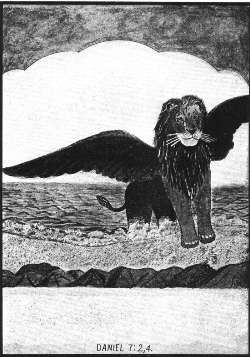
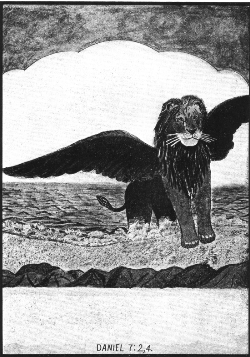
Coming back to the lion, symbol of Babylon, Daniel says: “The first was like a lion, and had eagle’s wings: I beheld till the wings thereof were plucked, and it was lifted up from the earth, and made to stand upon the feet as a man, and a man’s heart was given to it.” (Dan. 7:4.)   “His wings were plucked.”  The symbol denotes the same as the plucking of the three horns from the non-descript beast.  (Dan. 7:8.)  If the plucking up of the horns denotes their kingdom was taken from them, then plucking the wings signifies that Babylon, as empire number two was to pass away, fulfilling Daniel’s interpretation of the

Shepherd’s Rod book, Vol. 2                     42

handwriting on the wall: “This is the interpretation of the thing: Mene; God hath numbered thy kingdom, and finished it.” (Dan. 5:26.)  Therefore, Babylon fell into the hands of the Medo-Persian kings.  Thus his wings “were plucked,” and the Medo-Persian empire, number three, succeeded the lion, number two.Man’s Heart Given to It

After the wings of the lion were plucked, says Daniel: “He was made to stand upon his feet as a man, and a man’s heart was given to it.”  Whatever is meant by the position of the beast and the exchange of heart, its application is after Babylon had fallen under Medo-Persian rule, for he stood as a man after the wings “were plucked.”  If we are to acquire the understanding of the symbol, we must first consider the function of the heart, for the symbol itself must be perfect, otherwise the truth cannot be determined.

   The function of a heart is to preserve the life energy in the body.  Let the heart stop and all is lost.  This most vital organ is a governor of the body.  As an empire is composed of numerous individuals, and their necessities, just so is the living body composed of a multitude of life cells, and all their essentials.  As the duty of a king is to preserve the life energy in his kingdom, also punish or uproot the evil and to supervise the good, just so does the heart.  By contraction and expansion it controls and imparts the flowing, living energy in the form of pure blood.  The evidence gathered thus far Proves that the heart is a fitting symbol of a king.  But we must specify the difference between the human and the beastly heart.  Daniel 4:16, speaking of the penalty that was to fall upon the king before he was driven from his throne to the field with the beasts, says: “Let his heart be changed from a man’s and let a beast’s heart be given unto him; and let seven times pass over him.”  After the king’s heart was changed, he lost his reason, and by nature became equal to an ox.  “The same hour was the thing fulfilled upon Nebuchadnezzar: and he was driven from men, and did eat grass as an oxen and his body was wet with the dew of heaven, till his hairs were grown like eagles’ feathers, and his nails like birds’ claws.” (Dan. 4:33.)

   The human intellect does not consist in the external image of mankind, but it rather exists in the human heart.  This thought is very emphatically entertained by the scriptures: “For out of the abundance of the heart the mouth speaketh.”  Therefore, the symbol (man’s heart) may denote intelligence.  However, the symbol cannot infer human vision, but rather a proper

Shepherd’s Rod book, Vol. 2                     45

understanding of God, for the Bible says: “The fool hath said in his heart, there is no God.” (Psa. 53:1.) Obtaining a clear vision of the infinite power of the Eternal One is what God calls true education.  The sum of the symbol is, Babylon was forced to acknowledge the existence of the Most High by removing one king (beast’s heart) and setting up another (man’s heart).

   Having made clear what the symbol seems to indicate, we must take a brief survey of the ancient monarchy to see if this interpretation can be fully supported by the symbolical heart.  As the everlasting example set forth by the flood for future generations had failed to teach the Chaldean rulers God’s power and existence, the Creator of mankind in His mercy, patience and long suffering, not willing that any should perish, made a supreme effort to save that nation.  “The Lord is not slack concerning His Promise, as some men count slackness; but is long suffering to us-ward, not willing that any should perish, but that all should come to repentance.” (2 Peter 3:9.)

   When the dream of the great image was given to Nebuchadnezzar his memory of the object was blotted out, but the impression left in his mind was greatly increased.  After the urgent demand from the wise men had failed to reveal the king’s dream, Daniel, by divine revelation, unmasked the mysterious phenomena by interpreting the dream.  This wonderful miracle should have converted the king and all the wise men of Babylon to the Hebrew worship, for by the power of Daniel’s God they had escaped the death penalty; but there was no change for the better.  Though the king honored God with his lips, his heart drew away from Him.  The king destroyed not the idols in the land, but in his blindness proceeded to set up superior ones; for shortly after the interpretation of the dream he demanded of all his subjects the worship of the “golden image” which he had set up in the plain of Dura.  (Read the third chapter of Daniel.)

   The refusal of the three Hebrews to bow down to the idol, and the miracle by which they were saved from the fiery furnace, had deeply affected the minds of the rulers, but it too, failed to change the king’s heart.  Again he honored the God of gods with his lips but not by his deeds.  The king’s ungodly deeds made it necessary for a supernatural penalty.  Hence a tremendous effort to bring him to a realization of his dependence upon the Creator was necessary.  The dream given him (in Daniel four), of the great tree — a symbol of himself — and its interpretation by Daniel, had convinced the hard-hearted monarch of its truth, and the judgment that was to fall upon him, except he repent.  Daniel said: “Wherefore, O king, let my counsel be acceptable unto thee, and break off thy sins by righteousness,

Shepherd’s Rod book, Vol. 2                     46

and thine iniquities by shewing mercy to the poor; if it be a lengthening of thy tranquility…. At the end of twelve months he walked in the palace of the kingdom of Babylon…. The same hour was the thing fulfilled upon Nebuchadnezzar; and he was driven from men, and did eat grass as oxen, and his body was wet with the dew of heaven, till his hairs were grown like eagles’ feathers, and his nails like birds’ claws.” (Dan. 4:27, 29, 33.)

   At the end of the painful experience, the king said: “Now I Nebuchadnezzar praise and extol and honour the King of heaven, all whose works are truth, and His ways judgment: and those that walk in pride He is able to abase.” (Dan. 4:37.)  Though he acknowledged the power of the Eternal One, worshiped Him, and uttered words of praise with a most sublime expression, the king failed to surrender his heathen heart and renounce the pagan system of worship.  He failed to embrace the great importance of imparting the knowledge of Jehovah to his posterity for the tranquility and endurance of his kingdom.

   These wonderful experiences were for an object lesson to future kings.  Shortly after the fulfillment of the dream, the kings’ grandson had ascended the throne.  In his heathen custom he ventured to defy the God of gods, and the King of kings, who is able to make oxen out of kings and kings out of oxen, and rulers out of slaves.  “For promotion cometh neither from the east, nor from the west, nor the south.  But God is the judge: He putteth down one, and setteth up another.” (Psa. 75:6, 7.)

   The sacred vessels had never before been defiled by any king as in Belshazzar’s drunken feast.  God will forbear until man steps over the boundary line.  This Belshazzar did by bringing the sacred vessels before his lords, concubines, and heathen gods.  At the appearance of the hand writing on the wall his guilty conscience troubled him; his loins were loosed, and his knees smote one against the other.  Belshazzar, like his father, ignored Daniel and summoned the wise men of Babylon to interpret the writing; though he should have known their inability to reveal the secret.  At last Daniel was called and at his appearance he said: “This is the interpretation of the thing: Mene; God hath numbered thy kingdom, and finished it.  Tekel; Thou art weighed in the balances, and art found wanting.  Peres; Thy kingdom is divided, and given to the Medes and Persians.” (Dan. 5:26-28.)  The priceless experiences of his father that were at his access could have been everlasting blessings, but by ignoring the power of God the king reversed the benefits from a blessing to a curse, and brought a final end to his kingdom.  Every resource to make the lion (Babylon) stand up like a man under the rule of the Chaldean kings had been exhausted, and every effort failed.

Shepherd’s Rod book, Vol. 2                     47

Therefore, the time had come for the Lord to apply the last remedy to the lion kingdom.

   Cyrus, of whom God had spoken by His prophet many years in advance, was granted to enter the capital city of the Chaldean king.  (See Isa. 45:1.)   Babylon as empire number two passed away, and the symbol of the “plucked” wings met its fulfillment.  “In that night was Belshazzar the king of the Chaldean’s slain.”  The lion’s heart is a symbol of the heathen king — Belshazzar who was slain — and thus the beastly heart was removed.  Man proposes, but oftentimes another power over which he has no control, disposes.

   Daniel was made first president over the 120 princes because an “excellent spirit was found in him.”  Both Cyrus and Darius were converted to the worship of the true God.  Therefore, the everlasting Arm which intervenes in the affairs of mankind, set up a king of His own choice.

   In this manner the symbols met their fulfillment and the lion “was lifted up from the earth, and made to stand upon the feet as a man, and a man’s heart was given to it.”

   The heart is a fitting emblem of a ruler of a nation.  The contrast between a godly and an ungodly king is as vastly different as between the human and the beastly heart.  The heart is the life-giving energy to the human body, just as a king is the head of a nation.

   After freedom had been granted to the Jews, Cyrus, in his proclamation said: “Thus saith Cyrus king of Persia, The Lord God of heaven hath given me all the kingdoms of the earth; and He hath charged me to build him an house at Jerusalem, which is in Judah.  Who is there among you of all His people?  His God be with him, and let him go up to Jerusalem, which is in Judah, and build the house of the Lord God of Israel, (He is the God,) which is in Jerusalem.” (Ezra 1:2, 3.)  This godly influence of the kings of Medo-Persia did not wear out until years later.  The decree made by Cyrus was written in a roll and placed at Achmetha, in the palace that is in the province of the Medes.  Years later the roll being found by Darius, the edict was immediately carried out.  Cyrus had decreed that all should make a free will offering, and the king himself contributed without limit.  He said: “Moreover I make a decree what ye shall do to the elders of these Jews for the building of this house of God: that of the king’s goods, even of the tribute beyond the river, forthwith expenses to be given to these men, that they be not hindered.” (Ezra 6:8.)  He further decreed that all the needs to maintain the sacrificial services “be given them day by day without fail.” Then he added “That they may offer sacrifices

Shepherd’s Rod book, Vol. 2                     48

of sweet savours unto the God of heaven, and pray for the life of the king, and of his sons.” (Ezra 6:10.)  Nebuchadnezzar professed conversion after his wonderful experience with the God of heaven, and declared: “And all the inhabitants of the earth are reputed as nothing: and He doeth according to His will in the army of heaven, and among the inhabitants of the earth: and none can stay His hand, or say unto Him, What doest thou?  At the same time my reason returned unto me; and for the glory of my kingdom, mine honor and brightness returned unto me, and my counsellors and my lords sought unto me; and I was established in my kingdom, and excellent majesty was added unto me.  Now I Nebuchadnezzar praise and extol and honour the King of heaven, all whose works are truth, and His way judgment: and those that walk in pride He is able to abase.” (Dan. 4:35-37.)

   Though the sublime words spoken by the Chaldean king seems to reveal a change of heart, his works showed failure in what his lips proclaimed.  What a contrast between the Babylonian monarch, and the Medo-Persian kings! Nebuchadnezzar declined to set God’s people free, he refused to restore the sacred vessel to the King of heaven; he made no decree for the rebuilding of the house of God; he gave no gift of any kind to the King of kings; he imparted not the knowledge of Jehovah to his people; he left his children and his household to worship the heathen gods of wood and stone; he made no effort to give God the glory, save with his lips.

   Though we have these living examples before us, yet how often we admit by our lips that which is right and true, and make no move to reach for the stretched out Arm of divine love.  Multitudes are aping the standard set by the ancient monarch.  “This people draweth nigh unto me with their mouth, and honoureth me with their lips; but their heart is far from me.” (Matt. 15:8.)

   Though Nebuchadnezzar failed in these sacred things, God, in His great mercy saved the King.  God bore long with the Babylonian king, but “the once proud monarch had become a humble child of God; the tyrannical, overbearing ruler, a wise and compassionate king.  He who had defied and blasphemed the God of heaven, now acknowledged the power of the Most High, and earnestly sought to promote the fear of Jehovah and the happiness of his subjects.  Under the rebuke of Him who is King of kings and Lord of lords, Nebuchadnezzar had learned at last the lesson which all rulers need to learn.” — “Prophets and Kings,” p. 521.

Shepherd’s Rod book, Vol. 2                     49

Symbol of Wings and Ribs

January 14, 2026

We may now inquire the meaning of the wings on the lion and on the leopard; also the ribs in the mouth of the bear.  The wings on the lion certainly cannot represent speed, as some have taught.  If wings were to represent rapidity they should have been on the bear, for Cyrus and Darius conquered old Babylon over night.  Furthermore, if wings represent speed on one beast, they must likewise represent the same on the other.  Could they represent speed on the four-headed leopard beast?  Certainly not.  A careful observation of the symbols

Shepherd’s Rod book, Vol. 2                     33

show that the leopard beast had nothing to do with Alexander’s conquest of Medo-Persia.  The leopard represents the kingdom after the conquest was accomplished.  The four heads are the four Grecian divisions after the death of Alexander; namely, “Cassander, Lysimachus, Ptolemy, and Seleucus.”

   The conflict and conquest between Medo-Persia and Grecia is brought to our attention in Daniel 8:5-7: “And as I was considering, behold, an he goat came from the west on the face of the whole earth and touched not the ground: and the goat had a notable horn between his eyes.  And he came to the ram which had two horns, which I had seen standing before the river, and ran into him in the fury of his power.  And I saw him come close unto the ram, and he was moved with choler against him, and smote the ram, and brake his two horns: and there was no power in the ram to stand before him, but he cast him down to the ground, and stamped upon him: and there was none that could deliver the ram out of his hand.”

   In Dan. 8:20, 21, Daniel was told by the angel that the he goat “is Grecia,” the ram, “Medo-Persia,” and the notable horn between his eyes, is “the first king.”  Therefore, Alexander’s swift conquest is represented by the “he goat” which touched not the ground.  If wings were to represent speed they should have been on the “he goat” and not on the leopard.  Since the truth of what has been said cannot be denied, and as the thought that has been entertained by some is contradictory to the symbols, we must look elsewhere for the application of the “wings.”  We think it is far safer and wiser as well as more reasonable for one to admit his mistake — as we mortals are apt to make many of them — rather than to become involved in contradictory interpretations of the Word of God.

   First, we must understand that Inspiration is recording by means of these symbols the entire world’s history.  Let us not forget that there was a world before the flood.  If one of us should undertake this wonderful architectural feat to devise a blue-print, or chart, of this world’s history, we certainly would take into consideration a complete account of all its parts.  God being infinite in wisdom, as well as in power, would certainly not overlook or thoughtlessly neglect in His great chart of historical events to consider His world before the flood.

   A record of a divine survey of this world’s history from creation to redemption would be of great importance at this present time.  In an age of infidelity, atheism, and hypocrisy, men who profess to be wise in secular, as well as religious matters, have lost sight of the source of true wisdom and knowledge.  “Because that, when they knew God, they glorified Him not as God, neither

Shepherd’s Rod book, Vol. 2                     34


were thankful; but became vain in their imaginations, and their foolish heart was darkened.  Professing themselves to be wise, they became fools.” (Rom. 1:21, 22.)  Even those who profess to be teachers of righteousness, have forfeited their faith in the Biblical reckoning of creation.  God having knowledge of the present deceptive denial of His holy Word, has devised a prophetic blue-print in symbols of beasts, wings, ribs, horns, heads, crowns, etc., by which He points out in this prophetic panorama, the facts, with a force that should humiliate men and show them their utter ignorance and lack of wisdom.

   According to Biblical reckoning the flood came more than 1600 years after creation.  God originated the human race through Adam and Eve.  Therefore, one people, one race, one language and nation from creation to the flood.  The rulership given to Adam we call the first universal Adamic empire.  Babylon was the second; Medo-Persia is the third; Grecia the fourth; Rome the fifth; the broken state of Rome (symbolized by the feet and toes of the great image of Daniel 2, which is the present unstable civilization) is the sixth; and from the close of the millennium after the resurrection of the wicked to their second death, is the seventh and last.  Thus the Biblical number seven, as always, signifies, completeness.  Therefore, seven such universal empires, revealing a complete history of the world, denote the end of sin and its dominion.

   If we mortals were to devise such a chart by symbols of beasts, it is certain we would have sufficient intelligence to number every beast in his regular order.  We may not suppose that God is less thoughtful in His marvelous perfection.  Therefore, He has numbered every beast.  We must first consider those which represented the Old Testament time, by the great metallic image; namely, the Gold — Babylon; the silver — Medo-Persia; the brass — Grecia.  Gold is the chief of metals which would stand as number one; silver is second to gold, therefore number two; brass is third to gold, meaning number three.  The lion, the bear, and the leopard are numbered in like manner.  The lion is king or chief of beasts, therefore number one, corresponding with the gold.  The bear is second to a lion, therefore number two, corresponding with silver.  The leopard is third to a lion, hence number three, corresponding with the brass.  These are the first set of numbers, but there is yet another set of which we must speak.

   These would bring us back to our subject of what is the meaning of the wings on the lion as well as on the leopard, and the ribs in the mouth of the bear.  God certainly would not have mapped out the world’s history, from the flood to the end, and

Shepherd’s Rod book, Vol. 2                     41

failed to take into account all its parts.  There must be something in this chart of historical events to indicate that He had a universal empire before the flood, as previously explained.  That empire being the first, naturally stands as number one; Babylon number two; Medo-Persia, number three; and Grecia, number four.  If this claim is correct, we must find this set of numbers on the lion, bear and leopard.

   The wings on the lion denote empire number two.  The lion by nature is first — first from the flood but (unnaturally) by two wings, second from creation.  The ribs in the mouth of the bear signify empire number three.  The bear by nature is second from the flood, but (unnaturally), by three ribs he is third from creation; ribs are used, for wings go in pairs.  The four wings on the leopard denote that Grecia is the fourth universal empire.  The leopard by nature is third from the flood, but (unnaturally), by the wings, fourth from creation.  History flies, therefore wings make a perfect symbol.


(To be continued)

The Sanctuary is God’s temporary Throne Room

January 3, 2026

“We have also a more sure word of prophecy ” says the apostle Peter; “whereunto ye do well that ye take heed, as unto a light that shineth in a dark place, until the day dawn, and the day star arise in your hearts: knowing this first, that no prophecy of the scripture is of any private interpretation. For the prophecy came not in old time by the will of man: but holy men of God spake as they were moved by the Holy Ghost.” 2 Pet. 1:19-21.

Tract 3                            12

   The wise reader, therefore, will henceforth cease giving place to human theories and speculations which tempt him to the uttermost to make flesh his arm. He will instead attend diligently to Bible prophecy and to inspired interpretations and will learn therefrom that the sanctuary is

God’s Temporary Throne Room.

   Since earthly beings, themselves having never been in heaven, are naturally strangers to heaven’s realities (1 Cor. 2:9), then in order for God to make heavenly truth known unto them, He must reveal it by means of earthly realities with which they are familiar. Hence through the sanctuary work on earth is seen the sanctuary work in heaven (Heb. 9:1-9). Indeed, the sanctuary above being the pattern of the one below the services of the former are therefore definitely revealed in the services of the latter. And the fact that the earthly sanctuary was appointed as a place for confession and for forgiveness of sins, shows that the throne-room in the heavenly sanctuary is only temporary. From it, while sin exists, the Lord carries on the work of removing from the universe sin and sinners. And this light in turn clearly shows that not until after sin came into the universe could the sanctuary congruously have existed in heaven.

   “I looked,” exclaimed the Revelator about 96 A.D., upon being shown the throne in the sanctuary, “and behold, a

Tract 3                            13

door was opened in heaven: and the first voice which I heard was as it were of a trumpet talking with me; which said, Come up hither, and I will shew thee things which must be hereafter.

   “And immediately I was in the Spirit, and, behold, a throne was set in heaven, and One sat on the throne. And He that sat was to look upon like a jasper and a sardine stone: and there was a rainbow round about the throne, in sight like unto an emerald. And round about the throne were four and twenty seats: and upon the seats I saw four and twenty elders sitting, clothed in white raiment; and they had on their heads crowns of gold. And out of the throne proceeded lightnings and thunderings and voices: and there were seven lamps of fire burning before the throne, which are the seven Spirits of God. And before the throne there was a sea of glass like unto crystal: and in the midst of the throne, and round about the throne, were four beasts full of eyes before and behind.”

   “And I beheld, and, lo, in the midst of the throne and of the four beasts, and in the midst of the elders, stood a Lamb as it had been slain, having seven horns and seven eyes, which are the seven Spirits of God sent forth into all the earth….And I beheld, and I heard the voice of many angels round about the throne and the beasts and the elders: and the number of them was ten thousand times ten thousand,

Tract 3                            14

and thousands of thousands.” Rev. 4:1-6; 5:6,

   Here is brought to view a twofold scene.  On the one hand, before the throne are the “seven lamps burning” and the “Lamb as it had been slain,” showing that the throne was “set” there to serve in time of probation. The light from the candlestick represents the light of truth in the church while the blood of the Lamb is atoning for sinful beings. On the other hand, upon the throne sits the Ancient of days, the Judge, surrounded by the jury of twenty-four elders plus the angelic witnesses, “ten thousand times ten thousand, and thousands of thousands” of them, plus the four beasts (who, being “redeemed” “out of every kindred, and tongue, and people, and nation” — Rev. 5:8, 9, — are therefore symbolical of the saints,– all those whose sins will be blotted from the books of records, — just as the beasts of Daniel 7 are symbolical of all the kingdoms which will perish in their sins), with the Lamb, our Advocate, in the midst. All this shows a combined mediatorial-judicial work.

   Now so far, we see that when John in vision beheld the door — the veil — as it opened to the Most Holy apartment of the heavenly sanctuary, he was permitted to look within, and that the things which he saw, were to take place “hereafter” from his time; showing thereby that at the time of his vision (about 96 A.D.) the Most

Tract 3                            15

Holy apartment was closed. In addition to this, we shall now see from Daniel’s prophecy that the judgment throne was set up in the Most Holy apartment of the heavenly sanctuary after the “little horn” of Daniel 7 came up.

   “I considered the horns,” says the seer, “and, behold, there came up among them another little horn, before whom there were three of the first homs plucked up by the roots: and, behold, in this horn were eyes like the eyes of man, and a mouth speaking great things. I beheld till the thrones were cast down, and the Ancient of days did sit Whose garment was white as snow, and the hair of His head like the pure wool: His throne was like the fiery flame, and His wheels as burning fire. A fiery stream issued and came forth from before Him: thousand thousands ministered unto Him and ten thousand times ten thousand stood before Him: the judgment was set, and the books were opened.” Dan. 7:8-10.

   These verses reveal that after “the judgment was set, and the books were opened,” “the Son of man,” Christ, was then “brought” to a position, not at “the right hand of God,” “the Ancient of days,” but “near before” Him (Dan. 7:8-10, 13).

   Both John’s and Daniel’s visions reveal that the throne in the sanctuary was not there from the beginning of the creation of God; or from the days of Moses; or yet from the hour that Christ ascended on

Tract 3                            16

high; or even from the days of pagan Rome; that, indeed, it was not “set up” until after the fall of pagan Rome, when the “little horn” of the non-descript beast came up — in the days of Ecclesiastical Rome (Dan. 7:7-12, 21, 22). Elsewhere than in the sanctuary, therefore, is

God’s Eternal Throne Room.

   Because the sanctuary throne was not in existence in the days of the early Christian church, therefore the throne upon which Stephen saw Christ at the “right hand of God” (Acts 7:56) could not have been in the sanctuary, wherein is the “sea of glass,” but rather in Paradise, whence flows the “river of water of life,” and on either side of which is “the tree of life.” Rev. 22:1, 2. Very obviously, therefore, the throne which Stephen saw is “the throne of God and of the Lamb,” the throne permanent and eternal. Round about this glory-seat are no beasts, no witnesses, no jury, and before it is “no candle,” and no blood to be offered. In short, it stands, not in the sin-laden sanctuary, but in Paradise. It is the sovereign administrative throne, from which the Infinite eternally governs His immortal sinless beings!

   To this throne, then, which is from everlasting to everlasting, Christ ascended and thereat sat down at the right hand of His Father until the time came when, in fulfillment of Daniel’s prophecy and of John’s revelation, sometime after the little-horn

Tract 3                            17

power came into existence, both He and His Father moved to the sanctuary throne. Upon the latter He does not sit as a king at the right hand of God; but rather before it does He stand both as a sacrificial lamb (Rev. 5:6), and as an intercessor (Dan. 7:13) pleading for sinful human beings. Hence, His mediatorial work began

First In The Holy, Then In The Most Holy.

   In the earthly sanctuary the high priest (typifying Christ) officiated first in the holy apartment throughout the year, then upon the day of Atonement, the day of cleansing the sanctuary and judging the people, he officiated in the Most Holy for one day only. This twofold service signifies that in the heavenly sanctuary, the High priest, Christ, must necessarily first officiate in the holy apartment up to the antitypical day of Atonement, then during that day, He must officiate in the Most Holy apartment, before the throne. Thus the earthly services, too, repudiate the idea that Christ entered the Most Holy apartment of the heavenly sanctuary immediately after His ascension.

   Very plainly, then, the ceremonial system reveals that from the time Christ “sat on the right hand of God” (Mark 16:19), where the “river of water of life” is, to the time that He and the Father moved to the throne in the sanctuary, where “the sea of glass” is (Dan. 7:9, 10; Rev. 4.6), He

Tract 3                            18

officiated in our behalf as a high priest in “the holy place” (Heb. 9:12); and that at the same time, conjointly with the Father, on the eternal sovereign throne (“the throne of God and of the Lamb”), He ruled the sinless universe.” (Tract 3, Judgment and the Harvest)


How does a Christian celebrate Christmas?

December 20, 2025

As the Christmas holiday is fast approaching, it behooves us to correctly understand this long-held tradition. There is much we can filter through once we stay abreast of God’s advancing scroll of Truth. To be sure, if one does not look at this in a more full perspective, one may be caught up in being an extremist and steering from the “middle of the road” as the Lord’s Elijah message counsels.

For example, one “present truth” believer condemns those who even mouth the word “Christmas”. Yet Inspiration has never said such things. Many SDA think nothing of lighting their home Christmas tree and outside house lights during this season. Both positions are wrong and not in the counsel  of the Lord’s word.

Let us read —

“There is but one way of knowing that we are being led, by Christ our Lord, in the straight path to the pearly gates, and that is, by neither adding to nor taking from the Word of Truth, but by carefully following in the way of light, going not a step ahead of it, lingering not a step behind it, nor walking along its side-edges, but by following right in the middle of the road.

Hence, let not your zeal for progress drive you ahead of the light and make you to walk in the darkness; neither let your caution against running too far ahead cause you to drop back and lag behind; nor yet let carelessness verge you toward the edges.

Stay in the center of the road, where the light shines the brightest. Do not follow ideas, which stand upon implications, upon enlargements, upon diminishings,of the meaning of authoritative statements. Says Christ: “If any man shall add unto these things, God shall add unto him the plagues that are written in this book: and if any man shall take away from the words of the book of this prophecy, God shall take away his part out of the Book of Life.” (Rev. 22:18, 19.)

“But the prophet, which shall presume to speak a word in My name, which I have not commanded him to speak, or that shall speak in the name of other gods, even that prophet shall die.” (Deut. 18:20.) “Extremists never walk in the blaze of the light, but are always found ahead of it, and those who are passive invariably walk far behind it, while the careless and the indifferent stray to the edges.But those who are the true children of light never vary a step left or right, front or back from the brightest spot of the Christian’s narrow road”.”—3 SC 3-4:13

December 25th as Christ’s birthday —

There is no doubt that the “wide awake” Christians believe that Jesus was not born on Dec, 25. Further, we have Inspiration which also makes this case–

“The twenty-fifth of December is supposed to be the day of the birth of Jesus Christ, and its observance has become customary and popular. But yet there is no certainty that we are keeping the veritable day of our Saviour’s birth.

History gives us no certain assurance of this. The Bible does not give us the precise time. Had the Lord deemed this knowledge essential to our salvation, He would have spoken through His prophets and apostles, that we might know all about the matter. But the silence of the Scriptures upon this point evidences to us that it is hidden from us for the wisest purposes.

In His wisdom the Lord concealed the place where He buried Moses. God buried him, and God resurrected him and took him to heaven. This secrecy was to prevent idolatry. He against whom they rebelled while he was in active service, whom they provoked almost beyond human endurance, was almost worshiped as God after his separation from them by death.

For the very same purpose He has concealed the precise day of Christ’s birth, that the day should not receive the honor that should be given to Christ as the Redeemer of the world—one to be received, to be trusted, to be relied on as He who could save to the uttermost all who come unto Him. The soul’s adoration should be given to Jesus as the Son of the infinite God.” (Adventist Home, p. 477 )

“For over nineteen centuries the institution of Christmas, the popular gift-exchanging day, has been acclaimed throughout Christendom as one of God’s good and perfect gifts.  And this sentiment has been glorified and perpetuated in the face of the widely-known facts that Christmas is not the birthday of Christ, that He was not, in truth, born in December at all, that the observance of the day is simply a Christianized heathen custom perpetuated in charming Christian guise, and that it is not a gift from God.” (Tract 13, p.5)

The Christmas Tree —

The Scriptures and His Rod both are in agreement here. But regarding the Spirit of Prophecy (SOP) writings we see a little different angle.

“Thus saith the Lord, Learn not the way of the heathen, and be not dismayed at the signs of heaven; for the heathen are dismayed at them.  For the customs of the people are vain: for one cutteth a tree out of the forest, the work of the hands of the workman, with the axe.

   “They deck it with silver and with gold; they fasten it with nails and with hammers, that it move not.  They are upright as the palm tree, but speak not: they must needs be borne, because they cannot go.  Be not afraid of them; for they cannot do evil, neither also is it in them to do good.” (Jer. 10:2-5.)

“…Christmas is not, in reality, observed to the honor of the Saviour, but to the glorification of a heathen custom and to the gratification of the carnal heart.  Consequently, “altogether-Christians” cannot therefore consistently participate in celebrating the Christmas myth.  Indeed, to do so is openly to set at naught the Word of God, for “thus saith the Lord, Learn not the way of the heathen, and be not dismayed at the signs of heaven; for the heathen are dismayed at them.  For the customs of the people are vain: for one cutteth a tree out of the forest, the work of the hands of the workman, with the axe.” (Tract 13, p.6-7)

“Letters of inquiry have come to us asking, Shall we have a Christmas tree? Will it not be like the world? We answer, You can make it like the world if you have a disposition to do so, or you can make it as unlike the world as possible. There is no particular sin in selecting a fragrant evergreen and placing it in our churches, but the sin lies in the motive which prompts to action and the use which is made of the gifts placed upon the tree…. Let not the parents take the position that an evergreen placed in the church for the amusement of the Sabbath school scholars is a sin, for it may be made a great blessing.

Keep before their minds benevolent objects. In no case should mere amusement be the object of these gatherings. While there may be some who will turn these occasions into seasons of careless levity, and whose minds will not receive the divine impress, to other minds and characters these seasons will be highly beneficial. I am fully satisfied that innocent substitutes can be devised for many gatherings that demoralize.” (The Adventist Home, p.482)

How can this be assessed?  We think this is key, we go with “our present truth” , the current message from the Lord via His Rod is–do not “consistently participate” in this custom with its heathen practices. That’s what we are counselled and what we should do.Apparently those of Ellen White’s time we under different instructions on the “church” tree. Nowhere is SOP speaking of a “home tree” as is the heathen custom today.

Gift Giving —

“..the traditional gift-exchanging which is part and parcel of the spirit of Christmas observance, is a jealousy-breeding custom, all too often only cankering the receiver’s heart and emptying the buyer’s pocketbook.  Thus while it goads one multitude to display of pride, even luring them into revelry, debauchery, and immorality, it drives another, the multitude of poor, either to envy or discouragement, or to both, also not infrequently to despair, and sometimes to  insanity — even to committing murder and suicide.

The whole Christmas institution consequently being but a species of heathen worship that is demoralizing the nations, the Lord’s servants will invariably shun the exchanging of Christmas gifts, shun the evil attendant upon the occasion’s pretentious spirit and spurious humanitarianism.  Christians cannot, indeed, take part in its unholy  traffic of gift-trading and reveling, and at the same time be “altogether-Christians.” (Tract 13, p.7-8)
“The holiday season is fast approaching with its interchange of gifts, and old and young are intently studying what they can bestow upon their friends as a token of affectionate remembrance. It is pleasant to receive a gift, however small, from those we love. It is an assurance that we are not forgotten, and seems to bind us to them a little closer…. 

It is right to bestow upon one another tokens of love and remembrance if we do not in this forget God, our best friend. We should make our gifts such as will prove a real benefit to the receiver. I would recommend such books as will be an aid in understanding the word of God or that will increase our love for its precepts. Provide something to be read during these long winter evenings….

Thousands of dollars will be worse than thrown away upon the coming Christmas and New Year’s in needless indulgences. But it is our privilege to depart from the customs and practices of this degenerate age; and instead of expending means merely for the gratification of the appetite or for needless ornaments or articles of clothing, we may make the coming holidays an occasion in which to honor and glorify God.

Like the wise men of old, you may offer to God your best gifts and show by your offerings to Him that you appreciate His Gift to a sinful world. Set your children’s thoughts running in a new, unselfish channel by inciting them to present offerings to God for the gift of His only-begotten So.” (AH, p.478-480)

Another seemingly diametrically opposing counsel yes? Well, upon close examination maybe not. SOP says we can bring gifts that honor God. For example a Tithe offering to one of God’s “true” storehouses or maybe a present truth Tract or book to someone. In other words, gifts glorifying God and His cause.

Sadly, as of today, there is not any Children’s books on the Lord’s Elijah message. But we are working on that. For it would be a great gift for the Children. Notice that we can set our “..children’s thoughts running in a new, unselfish channel by inciting them to present offerings to God for the gift of His only-begotten Son.”

The Christmas purpose —

“While to a multitude of Christmas-observers, Christ means scarcely more than any ordinary man of fame, to an even greater Christmas-observing multitude of “not-at-all-Christians,” He is but a storied figure by which to conjure holiday revelry; although they meaninglessly lip His name in conventional acknowledgment of the supposed origin of the religious occasion of the season!  Thus to many, like a light in the darkness, stands out the fact that Christmas is not, in reality, observed to the honor of the Saviour, but to the glorification of a heathen custom and to the gratification of the carnal heart.  Consequently, “altogether-Christians” cannot therefore consistently participate in celebrating the Christmas myth.” (Tract 13, p.6-7)

“As the twenty-fifth of December is observed to commemorate the birth of Christ, as the children have been instructed by precept and example that this was indeed a day of gladness and rejoicing, you will find it a difficult matter to pass over this period without giving it some attention. It can be made to serve a very good purpose. 

The youth should be treated very carefully. They should not be left on Christmas to find their own amusement in vanity and pleasure seeking, in amusements which will be detrimental to their spirituality. Parents can control this matter by turning the minds and the offerings of their children to God and His cause and the salvation of souls….Let there be recorded in the heavenly books such a Christmas as has never yet been seen because of the donations which shall be given for the sustaining of the work of God and the upbuilding of His kingdom.” (AH, p.478, 482)

Summary —

As we mentioned in the top of the post we must strive to “Stay in the center of the road, where the light shines the brightest.” Thus, when we look at God’s word as said in the above references, we can see an underlining harmony.

The Christmas season is nearly all encompassing of heathen worship and customs. Yet we can turn it around by doing what God’s Spirit of Prophecy says. Gifts such as offerings to His storehouses, present truth literature to those we think may be enlightened, and teaching our children about Christ and focusing on HIM that day. It can indeed be  a day of — sustaining of the work of God and the upbuilding of His kingdom.”

WHO ARE THE WOMAN AND HER REMNANT?

November 14, 2025

Question No. 26:

What does Revelation 12:13-17 mean?

Answer:

“And when the dragon saw that he was cast unto the earth, he persecuted the woman which brought forth the man child. And to the woman were given two wings of a great eagle, that she might fly into the wilderness, into her place, where she is nourished for a time, and times, and half a time, from the face of the serpent. And the serpent cast out of his mouth water as a flood after the woman, that he might cause her to be carried away of the flood. And the earth helped the woman, and the earth opened her mouth, and swallowed up the flood which the dragon cast out of his mouth. And the dragon was wroth with the woman, and went to make war with the remnant of her seed, which keep the commandments of God, and have the testimony of Jesus Christ.” Rev. 12:13-17.

Nearly all Christians agree that the only tenable interpretation of the “woman” here mentioned, is that she symbolical the church. And the fact that she gave birth to the man child, Christ, shows that she is therefore symbolical of the church in at least the Christian dispensation.

While the dragon was persecuting her through the deceived Jewish priests who rejected Christ as the Messiah, “there was a great persecution against the church which was at Jerusalem; and they were all scattered abroad throughout the regions of Judaea and Samaria, except the apostles. And devout men carried Stephen to his burial, and made great lamentation over him. As for Saul, he made havock of the church, entering into every house, and haling men and women committed them to prison. Therefore they that were scattered abroad went everywhere preaching the Word.” Acts 8:1-4.

To her were therefore given the wings of a great eagle—her means of transport into the wilderness. And being the opposite of the vineyard (“the house of Israel, and the men of Judah His pleasant plant”—lsa. 5:7), the wilderness obviously denotes the Gentile nations. The apostles, therefore, in fulfillment of this prophecy were commanded, and given the wings, speedily to go preach to all nations.

“Then Paul and Barnabas waxed bold, and said, It was necessary that the Word of God should first have been spoken to you: but seeing ye put it from you, and judge yourselves unworthy of everlasting life, lo, we turn to the Gentiles. For so hath the Lord commanded us, saying, I have set thee to be a light of the Gentiles, that thou shouldest be for salvation unto the ends of the earth. And when the Gentiles, heard this, they were glad, and glorified the Word of the Lord: and as many as were ordained to eternal life believed. And the Word of the Lord was published throughout all the region.” Acts 13:46-49.

Seeing this, the serpent sought to destroy the woman’s usefulness among the Gentiles: he “cast out of his mouth water as a flood after the woman, that he might cause her to be carried away of the flood.” Rev. 12:15.

Anyone can see that this “flood” can represent only the church’s suddenly becoming infiltrated with unconverted pagans who, as in Constantine’s time and for years thereafter, were even taken en masse and forced into baptism. In the parables of Christ this same “flood” is described, but under the different term, “tares.” And the evident fact that they are still very much in the church, forces the painful realization that the earth has not as yet swallowed up the flood.

“Flood” and “tares” are figurative equivalents. The swallowing of the flood, therefore is the same as the burning of the tares as comprehended in the parable of the harvest (Matt. 13:3).

Besides, the Revelator points out that not until after the flood is swallowed by the earth after the unconverted are “slain” and buried and the church thereby purified, will the dragon wage his fiercest warfare against the remnant of the woman’s seed. Hence, the harvest time in the church, the time the earth swallows the flood, is before the dragon wars against the remnant.

“Fruits” garnered are the result of a harvest. When the 144,000, the first fruits (Rev. 14:4), are garnered in, and the tares (flood) are destroyed (swallowed) from among them, the 144,000 are taken to Mt. Zion, where they then comprise the Mother church, the twelve-star-crowned woman, under the protection of the Lamb, the One with them. Thus protected, she is secure from the dragon’s then making war against her. So he wars only against her “remnant,” those yet to be garnered-the second fruits still scattered throughout the world, away from Mt. Zion. This climax of the ages was vividly foretold by both Isaiah and Micah:

“But in the last days,” declares Micah, “it shall come to pass, that the mountain of the house of the Lord shall be established in the top of the mountains, and it shall be exalted above the hills; and people shall flow into it. And many nations shall come, and say, Come, and let us go up to the mountain of the Lord, and to the house of the God of Jacob; and He will teach us of His ways and we will walk in His paths: for the law shall go forth of Zion, and the Word of the Lord from Jerusalem.” Mic. 4:1, 2. (See also Isaiah 2).

From these scriptures, it is plainly seen that Mt. Zion becomes the headquarters for the last gospel work on earth, after the time the 144,000 arrive there, and during the time the dragon wars against the remnant “for the law shall go forth of Zion, and the Word of the Lord from Jerusalem”-no longer from the General Conference, or from Mt. Carmel Center.

Then shall many nations say, “Come, and let us go up to the mountain of the Lord and to the house of the God of Jacob; and He will teach us of His ways, and we will walk in His paths.” Mic. 4:2. (Answerer, vol. 2, Question 26)

The parable of Matthew 20:1-16 (part 1 of 2)

October 26, 2025

  “For the kingdom of heaven is like unto a man that is an householder, which went out early in the morning to hire labourers into His vineyard. And when He had agreed with the labourers for a penny a day, He sent them into His vineyard.  And He went out about the third hour and saw others standing idle in the marketplace, and said undo them; Go ye also into the vineyard, and whatsoever is right I will give you.  And they went their way.  Again He went out about the sixth and ninth hour, and did likewise.  And about the eleventh hour He went out, and found others standing idle, and saith unto them, Why stand ye here all the day idle? They say unto Him, Because no man hath hired us.  He saith unto them, Go ye also into the vineyard; and whatsoever is right, that shall ye receive.” Matt. 20:1 -7.

   How can we know for a certainty in which hour we find ourselves, and if our own call to service has come?  We can know only by establishing the time in which the last parabolic hour expires.  And to do this we must first establish the time of the first call for servants, then in turn the time of each successive call, culminating with the last.  First, though, pursuant to this end, we must bring into focus the parable’s significant points:

   (1) The “Householder,” as every Bible student knows, is the Lord Himself.  (2) The Laborers are His servants.  (3) The penny is their reward.  (4) His vineyard is the place where they are to labor.  (5) The day is parabolical — representing a period of time which is illuminated by some great light.  (6) The period of labor is both preceded

The White-House Recruiter  13

and succeeded by a night — else there could be no “early” and no “late” part of the day.  (7) The Householder hires laborers at five different times. (8) There are four three-hour periods.  (9) In each of the first three periods, only one group is hired.  (10) In the fourth and last period of three hours, two groups are hired.  (11) The agreement for a penny a day is made only with the first group.  (12) The other groups are to receive “whatsoever is right.”  (13) At the day’s end all are given the same pay — a penny, even through the last worked only an hour.  (14) The first were paid last; the last, first.

   Now to find out in which hour we are told, “Go ye also,” we must here at the outset of this go-to-work study, determine where in time the parable begins and where it ends.  To gain this vital knowledge is simply to reckon with the sequentially amplifying facts that the parabolical night which preceded the parabolical day must necessarily be the period before the spiritual “Light of the world,” the Bible, came up — before the light of the Scriptures, the written Word of God, began to shine forth into the hearts of men.  For back there, it must be remembered, the will of God was transmitted, not by the Bible, but orally from father to son, just as the light of the sun at night is transmitted to the earth by the moon, rather than directly by the sun itself.  For this reason it has come to be regarded as the time of oral tradition.

   But the day of labor obviously represents the period in which “the Light of the world,” the Bible Itself, lightens man’s path.  Thus it is that in His parable, the Master, the Lord of the vineyard, regards the Old and New Testament dispensations as the only day period of all probationary time, in which He goes to the market-place at

The White- House Recruiter  14

five consecutive times to hire servants to work in His vineyard.

   Finally, the night following the day can only represent the period after the gospel work is finished, after probation for man’s salvation is closed. Then, as the “Light of the world” (the Word of God) sinks beyond the horizon of the day, darkness covers “the earth, and gross darkness the people.” Isa. 60:2.  It is the time which finds the destiny of every being forever fixed.  Then follows the Lord’s irrevocable finality:

   “He that is unjust, let him be unjust still: and he which is filthy, let him be filthy still: and he that is righteous let him be righteous still: and he that is holy, let him be holy still.” Rev. 22:1 1.

   It is the time when men “shall run to and fro to seek the Word of the Lord, and shall not find It” (Amos 8:12); the time when the unmindful of the Master’s call, and the impenitent of sin realize and cry out in frenzied and agonized despair: “The harvest is past, and the summer is ended, and we are not saved”! Jer. 8:20.

   The truth is now become clear that the parable divides the time of salvation into two equal parts of twelve symbolical hours each — the period before the Bible (the night), and the period during the Bible (the day).  Lending additional force to the fact that the parable thus divides time, Jesus declares:

   “Are there not twelve hours in the day?  If any man walk in the day, he stumbleth not, because he seeth the Light of this world.” John 11:9.

The White-House Recruiter  15

   Proceeding now, we come to another point of special significance: the first four groups were hired at consecutive intervals three parabolical hours apart; whereas the fifth, the last group, the one hired at the eleventh hour, came only two, instead of three, hours later than the fourth group, and thus only one parabolical hour before the day’s end — shortly before probation closes.

   This two-hour period, from the ninth hour to the eleventh hour, is a singularity which comes as a climactic exception to the master pattern of sequential and regular three-hour intervals between calls.  It obviously reveals that the last call comes unexpectedly and surprisingly within the period of the ninth-hour group.  Hence there are only two parabolical hours for the one group, and only one parabolical hour for the other group.

   To determine the identity of the laborers participating in each of the five different calls, we necessarily begin our quest with THE SERVANTS OF THE FIRST CALL:

   We have already seen that it is the Bible, the spiritual “Light of the world,” that makes the parabolical day.  We all know, moreover, that the Bible arrived with the Exodus movement also the since the arrival, the Lord never bargained, as it were with another people, and that they were the only ones to whom He ever committed the ceremonial covenants and all their rewards and promises.  Inescapably, therefore, the first group of the parable, those who went to labor “early in the morning,” at the rising of the spiritual light, the Bible, and with whom the bargain was made to receive a penny a day, were ancient Israel as they were going out of Egypt, the time of which

The White-House Recruiter  16

was early in the parabolical day.  In concord the Spirit of Prophecy declares:

   “The Jews had been first called into the Lord’s vineyard….” -Christ’s Object Lessons, p. 400.

   At that early hour, as God began to indite the Scriptures (as the Light that lightens the hearts of men began to rise), “He…remembered His covenant forever, the word which He commanded to a thousand generations.  Which covenant He made with Abraham, and His oath unto Isaac, and confirmed the same unto Jacob for a law, and to Israel for an everlasting covenant.” Ps. 105:8-10.

   Having thus by the first call for servants solidly established the time in which the parabolical go-to-work calls started, we are now to ascertain the call-time and work-period of THE SERVANTS OF THE SECOND CALL:

   The second group, those sent at the third parabolical hour, must necessarily be the ones who were called to the work next.  And they were, of course, the early Christians.  Significantly enough, too, the Lord was crucified at the third hour of the day (Mark 15:25), and likewise Pentecost came at the third hour of the day (Acts 2:15).

   Another point of significance of which we should take note is the fact that the messages borne by these first two groups, by ancient Israel and by the early Christians, were not of a reformatory nature; they were not old, forgotten truths in process of revival and restoration; rather each was a new revelation, “meat in due season” — present Truth especially adapted fully to meet the needs of the people in their respective times. The former group

The White-House Recruiter  17

were inspired and commissioned to teach and practice the truths of salvation as embodied in the ceremonial system, the latter group were inspired and commissioned to teach and practice the same immutable truths in their advanced light-advanced from typical to antitypical representation, from the ministration in the earthly tabernacle to the ministration in the heavenly one; that is, from the sacrifice of a lamb of the flock to the sacrifice of Christ Himself, the Lamb of God.  Thus the latter group taught the old truths in a new and original light, in the light of the gospel — that Christ was crucified for the remission of sin, resurrected in triumph over sin and death, and ascended to make atonement and reconciliation for the penitent sinner, not in an earthly, but in an heavenly, tabernacle.

   Since the messages of the first two groups (the one carried by the Exodus Movement, and the other carried by the Christians) were each in their respective times fresh from glory, that fact logically establishes itself as Divine precedent and pattern for all the messages of the parable. Accordingly, each of the three remaining groups must likewise be entrusted with a message of new and distinctive revelation, of “meat in due season” — truth adapted especially and fully to meet the needs of God’s people at the time then present.  Therefore we need only to trace down through the annals of church history the unfolding of the scroll, till we come upon a newly and originally revealed and proclaimed truth subsequent to the message of the first advent of Christ It must point out THE SERVANTS OF THE THIRD CALL:

   The Protestant Reformation, being purely an endeavor to restore old, down-trodden truths, and not to reveal new, advanced ones, had no new message of its own – nothing

The White-House Recruiter                18

that had not already been taught in times past.  It therefore follows that the third group and message must be sought during the years following the Reformation.

   The only revelation of new prophetic truth, subsequent to the Reformation, is the announcement of the year in which was to begin the work of cleansing the sanctuary, primarily in behalf of the dead (based on Daniel 8:14, but not then fully understood).  As its announcement was made by the First-day Adventists, it necessarily follows that they were the third group of servants with a new and distinctive message.  And as is well known, they started proclaiming it in the year 1833, announcing that the cleansing of the sanctuary was to commence in the year 1844.  Thus in 1833 the clock of parabolic time struck the hour of six.”

…to be continued

The Truth on “Three days and three nights” (Matt. 12:40)

August 8, 2025

THREE DAYS AND THREE NIGHTS IN THE HEART OF THE EARTH

The question as to how long Christ remained in the tomb, and the day on which He was buried and resurrected, has been as widely discussed as any other Biblical subject.  A number of theories have been advanced and doubtless much valuable time has been wasted, however, confusion upon the subject has not lessened, but rather increased.

   Some one has asked, “What has that to do with our salvation?”  It may not have much to do with the salvation of some, but it seems that with others it has a great deal to do.  A certain sister said: “I believe all the S—– denomination teaches, but I cannot agree with the position Sister W—- holds on the subject of Christ’s burial and resurrection.  I know that Christ was three days and three nights in the tomb, but Sister W—- states He was buried on Friday evening and resurrected on Sunday morning.  Therefore, I cannot believe in all her writings, and for this reason I have not, and will not, become a member of your church.”

   The misunderstanding of this question has kept this sister from connecting with the church.  Now, if that particular denomination has the truth for the world at this present time, and this sister’s misunderstanding has kept her from accepting it, then we must concede that this widely discussed subject has something to do with the salvation of some people, to say the least.

   Said Jesus: “Ask, and it shall be given you; seek, and ye shall find; knock, and it shall be opened unto you: For everyone that asketh receiveth; and he that seeketh findeth; and to him that knocketh it shall be opened.” (Matt. 7:7, 8.)

   There could be nothing more pleasing to God than for one of His children to ask in faith the way of truth.  If there is any power in the words of Jesus, then surely he who desires to know the truth and is willing to obey it, though it may demand that he sell all and give to the poor, renounce the world and all its inducements, it would be impossible for that soul to remain in darkness.  Let the searcher after truth make just such a vow to God and thus try out His power and never failing promises

Shepherd’s Rod book, Vol. 2                     17

through the words of His Son.  But though it be possible to deceive men, we can never impose upon God, for He knows what is in the heart.

   One of the chief reasons why confusion arises among Bible students is because they do not entirely depend on the Biblical expression of the words.  They think themselves wiser than the prophets who were inspired with the Spirit of God, and thus wish to correct the words and meaning of the Holy Bible!  Hence finite mortals have attempted to rectify and correct the Infinite One, whose wisdom, power, and vision is unsearchable!  Though they know their interpretation of a text is not altogether in harmony with the whole tenor of the book and law, they see no injury, and fear not God.  And when the fact is revealed they refuse to exchange error for truth because it contradicts their false theology.  We invite the earnest attention of the reader upon this subject and that he take notice of the wonderful harmony of the Scriptures and the great wisdom used in them.

   The sister was asked: “Where is your evidence that Christ was three days and three nights in the tomb?”  “My answer is,” she said, “in Matthew 12:40, ‘For as Jonas was three days and three nights in the whale’s belly; so shall the Son of man be three days and three nights in the heart of the earth’.”  Again she was asked, “On what day do you think Christ died?”  She said,  “John 19:31 has the answer: ‘The Jews therefore, because it was the preparation, that the bodies should not remain upon the cross on the Sabbath day, (for that Sabbath was an high day,) besought Pilate that their legs might be broken, and that they might be taken away.’ ”  Here she explained that it could not have been the preparation for the seventh-day Sabbath, for that Sabbath was an “High” day, so it was the preparation for the passover — Wednesday.  Then she began to count, “Thursday (1) Friday (2), Saturday (3); Wednesday night (1), Thursday night (2), Friday night (3).  Thus there are three days and three nights.”

   According to this sister’s reasoning she thinks her explanation is unquestionably correct.  But not that Christ died at the ninth hour, just three hours before the end of the day (Matt. 27:46-50) and was buried at sunset — 12 o’clock.  (Luke 23:52-56.)

   If He was buried on Wednesday, He would have been three full days and four full nights in the tomb, for the Bible plainly declares: “In the end of the Sabbath, as it began to dawn [daybreak] toward the first day of the week, [Sunday A.M.] came Mary Magdalene and the other Mary to see the sepulchre.” (Matt. 28:1.) Again we quote from Mark 16:9, “Now when

Shepherd’s Rod book, Vol. 2                     18

Jesus was risen early the first day of the week, He appeared first to Mary Magdalene.”

   Let us examine the theory from another angle.  Said Jesus: “Ye know that after two days is the feast of the passover, and the Son of man is betrayed to be crucified.”  (Matt. 26:2.)  “Then [after the two days] assembled together the chief priests… and consulted that they might take Jesus by subtilty, and kill him.”  (Matt. 26:3, 4.)  The time Christ said the words: “Ye know after two days is the feast of the passover,” could not have been later than the beginning of Tuesday, if the feast of the passover was on Thursday.  Then all that took place in connection with His judgment, crucifixion, death, and burial, had to be accomplished from late Tuesday morning to sunset Wednesday, which would have been impossible according to the Biblical time table as we shall endeavor to set forth.

   Note the following Scriptures: “Now the first day of the feast of unleavened bread the disciples came to Jesus, saying unto him, Where wilt thou that we prepare for thee to eat the passover?”  This was the preparation day for the feast of the Passover.  “And He said, Go into the city to such a man, and say to him, The Master saith, My time is at hand; I will keep the passover at thy house with my disciples.  And the disciples did as Jesus had appointed them, and they made ready the passover.  Now when the even was come, he sat down with the twelve.  And as they did eat, he said, Verily I say unto you, that one of you shall betray me.” (Matt. 26:17-22.)  The passover feast can only be observed after sunset at the beginning of the first day of unleavened bread: “In the fourteenth day of the first month at even is the Lord’s passover.” (Lev. 23:5.)  This is the last day of preparation for the passover.  Therefore, Jesus was not yet in the hands of the priests on the preparation for the passover feast, and much less crucified.  Furthermore, Matthew is altogether clear on the subject and leaves no room for argument: “And as they did eat, [the passover] he said, Verily I say unto you, that one of you shall betray me.” (Matt. 26:21.)  How could Jesus eat the passover with the twelve had he been crucified and buried?  We are ready to accept truth, but when the theory is contradicted by the Scriptures, then we must not submit to erroneous conclusions, for, he who believes a lie is an abomination unto God.

   Permit us to clear the controversy by facts that can stand the test.  Let the reader bear in mind that the passover is a seven-day affair, or what is called the “passover week.”  We quote Lev. 23:4-8: “These are the feasts of the Lord, even holy convocations, which ye shall proclaim in their season.  In the

Shepherd’s Rod book, Vol. 2                     19

fourteenth day of the first month at even is the Lord’s Passover.  And on the fifteenth day of the same month is the feast of unleavened bread unto the Lord: Seven Days ye must eat unleavened bread.  In the first day ye shall have an holy convocation: ye shall do no servile work therein.  But ye shall offer an offering made by fire unto the Lord seven days: in the seventh day is an holy convocation: ye shall do no servile work therein.”

   Now mark, the seventh-day Sabbath is controlled by the weekly cycle, and the passover by the monthly calendar.  Therefore, in each passover week there is a seventh-day Sabbath and it may fall on any one of the seven paschal days.  Again, mark that the fourteenth day is called the “Passover” day, but the fifteenth is the Passover “Feast.”  (See Num. 28:17;  Joshua 5:11.)  The seventh-day Sabbath is called, “The Sabbath.”  The sheaf offering was the first fruits of the harvest and it was to be offered before the Lord on the morrow after the Sabbath, that is, on the first day of the week, commonly called Sunday.  (See Lev. 23:11.)  The sheaf offering was a type of the resurrection — the first fruits.  Said the apostle: “But now is Christ risen from the dead, and become the first fruits of them that slept” — those whom He raised.  (1 Cor. 15:20;  also Matt. 27:52, 53.)

   Thus Christ “led captivity captive” on the very day to which the type pointed. 

The Passover Preparation

   The passover is a feast of seven days; therefore, the preparation for the week required longer than a day.  Quoting Ex. 12:3, 6, “In the tenth day of this month [the first] they shall take to them every man a lamb… And ye shall keep it up until the fourteenth day of the same month.”  The people were commanded to commence the preparation on the tenth day of month.  On the fourteenth day, before sunset, all leaven was to be put out from their houses.  Then the fifteenth day drew on, being the first day of unleavened bread, and the passover week commenced by killing the passover lamb.  “Seven days shall ye eat unleavened bread even the first day ye shall put away leaven out of your houses.” (Ex. 12:15.)  Therefore, the fourteenth day was the last day of preparation, and the fifteenth, or the first day of the feast, was a holy convocation, and they were to do no servile work therein.  Matthew 26:17, has reference to the same day upon which Jesus ate the passover with the twelve.  (See Matt. 26:20, 21.)

   The only possible days for the passover week would be as

Shepherd’s Rod book, Vol. 2                     20

Click on chart To View details.

Shepherd’s Rod book, Vol. 2                     21, 22

follows: The fourteenth day of the first month that year was on Wednesday, and the day ended at sunset (even).  The first day of the passover feast (15th day of the month) came on Thursday; the second, on Friday; the third, on Saturday (Sabbath); the fourth, on Sunday; the fifth, on Monday, the sixth, on Tuesday; the seventh and the last of the feast on Wednesday the 21st day of the month.  (Follow chart on page 22). 

Time Table From Passover To the Resurrection

   The lamb could not be killed before the fourteenth day at even and be called “The Passover Lamb” according to the instruction given in the following Scriptures: “And the whole assembly of the congregation of Israel shall kill It (the lamb) in the evening.” (Ex. 12:6.)  Suppose everything was ready and the lamb was killed as soon as the sun went down.  It would take about fifteen minutes for it to die; then the pelt must be removed.  In addition to this every part of it had to be dressed, washed, and placed back in the sacrifice and the opening sewed together, for there was not any part of it to be thrown away, save the waste.  Therefore, the preparation for roasting the sacrifice would require not less than an hour.  Thus we read: “Eat not of it raw, nor sodden at all with water, but roast with fire; his head with legs, and with the purtenance thereof.” (Ex. 12:9.)

   The ancient method of roasting required more time than our modern way.  A rod was drawn through the sacrifice, then it was placed over coals of fire, and kept continually turning about by means of the rod.  This method of roasting would require about four hours.  To eat the passover ordain the Lord’s supper, and the ordinance of humility, then sing a hymn, would have added another hour and a half.  Afterwards they went to the mount of Olives.  (See Mark 14:26.)  The mount is about one half mile east of the third wall of the city.  Therefore, it was some distance from the place where the passover was celebrated.  Thus it would have taken them close to half an hour to get there on foot; after which Jesus took the three to the garden of Gethsemane.

   There could not have been less than an hour and a half spent on the mount and in the garden while Jesus prayed; after which the apostles were told to take their rest in sleep, for Jesus went out to pray three times, and on returning, twice He found them sleeping, “and He cometh unto the disciples, and findeth them asleep, and saith unto Peter, What, could ye not watch with me One Hour?” (Matt. 26:40.)  We may suppose they

Shepherd’s Rod book, Vol. 2                     23

spent at least an hour in sleeping, otherwise the words of the Master on His third return: “Take your rest” (Matt. 26:45), would have been spoken in vain.  After these experiences Judas arrived with the multitude and there was a little time spent in taking Jesus; and by the time they led Him to the priests it must have consumed not less than two hours.  According to this computation of time, the total of hours spent from sunset Wednesday evening (beginning of the passover by killing the lamb) to the time Jesus was led to the high priest could not have taken less than twelve hours.

   The analysis of the foregoing time table, proves that when Jesus was led to Caiaphas, the high priest, it was about the twelfth hour, or shortly before daylight on Thursday morning; and after His trial before the high priest, “Then led they Jesus from Caiaphas unto the hall of judgment: and it was early.” (John 18:28.)  “And it was the Preparation of the passover, and about the sixth hour: and he [Pilate] saith unto the Jews, Behold your King!” (John 19:14.)  As John states that it was early when they led Him from Caiaphas to the hall of judgment, and as he also states that it was about the sixth hour (either midnight, or midday according to ancient time), then it must have been shortly after midnight (about the sixth hour) when Pilate said to the Jews, “Behold your King,” for John would not call midday, early.  Therefore, after He had been judged by the Sanhedrin they called Pilate, and then went to the hall of judgment.  This was done on the morning of the day following, after they had taken Jesus from the garden — early Friday morning.

   Says John, “And it was the preparation of the passover.”  We have previously explained that the preparation for the passover lamb was not one day, but rather a four day affair.

Furthermore, Matthew plainly says: “They made ready the Passover.  Now when even was come, He [Christ] sat down with the twelve.  And… they did eat.” (Matt. 26:19-21.)  Therefore, the passover preparation mentioned by John, cannot be the preparation for the passover lamb, but rather the preparation for the passover Sabbath (the seventh-day), called the passover preparation, because it was in the passover week, as it occurred only once a year.  So then, that Friday is called “the preparation of the passover.”  Thus, the seventh-day Sabbath in the passover week was called a “High Day,” because it was a Sabbath within a Sabbath — the highest day in the year.

   According to time tabulation, the Jewish rulers tried Jesus from twelve o’clock Thursday morning, to about six o’clock Friday morning (ancient time).  Nine hours later — at the third hour (Friday), Jesus was crucified.  (See Mark 15:25.)  After

Shepherd’s Rod book, Vol. 2                     24

He had been on the cross for three hours the sun was darkened (at six o’clock — noon.  See Mark 15:33.)  Three hours later Jesus died and the sun again gave light.  (See Matt. 27:45-50.)  In the three remaining hours to sunset, very hasty preparation was made and the Saviour was placed in Joseph’s new tomb just before the seventh-day Sabbath drew on.  We quote Luke 23:53-56: “And he took it down, and wrapped it in linen, and laid it in a sepulchre that was hewn in stone, wherein never man before was laid.  And that day was the preparation, and the Sabbath drew on.  And the women also, which came with Him from Galilee, followed after, and beheld the sepulchre, and how His body was laid.  And they returned, and prepared spices and ointments; and rested the Sabbath day according to the commandment.”  Thus Jesus remained in the tomb from twelve o’clock Friday evening to about twelve o’clock Sunday morning.  This is also proven by Mark 16:9, “Now when Jesus had risen early the first day of the week.”  Therefore, a total of about thirty-six hours in the tomb; and a grand total of eighty-four hours from the commencement of the passover to the resurrection.

   Now mark, that from the time the Jews laid hands on Christ (Thursday the 12th hour) to His resurrection (Sunday the 12th hour), there were exactly seventy-two hours or three days and three night.  Thus fulfilling the words of Jesus: “For as Jonas was three days and three nights in the whale’s belly; so shall the Son of man be three days and three nights in the heart of the earth.” (Matt. 12:40.)  The idea that in the “heart of the earth” means in the grave, is man’s supposition without Bible foundation.  If the Saviour had in mind His experience in the grave, He would have said so.  If His grave was in the center of the earth — about 4,000 miles beneath its surface (the heart of the earth) then one may suppose He meant the heart of the earth.  Jesus used the expression to indicate that He was to be three days and three nights in the hands of sinners, and in the grave.  Why are sinners called “The heart of the earth”?  Because man was made of it according to Gen. 3:19, “For dust thou art, and unto dust shalt thou return.”

   At this point we draw the reader’s attention to the chart on page 22.  Take notice of the infinite wisdom used to devise the picture of the great sacrifice (the Cross) for human beings, which is an evidence of boundless love Divine.  Note first, that the hand on the clock dial made its round three times.  Mark that each event was three hours apart (3 x 9 and 6 x 12), making the cross.

   Now observe that the position of the cross as it is on the dial, does not show the proper proportion.  But if the reader will

Shepherd’s Rod book, Vol. 2                     25

turn the diagram upside down as it were, which would show the way the ancient clock measured time — being regulated by sunset at twelve o’clock, then the cross appears in its perfect form; thus we have another view of divine perfection.

   The line across the dial between the hours of four and five, ten and eleven — marked north and south pole, gives the exact position of the globe as it travels on its yearly orbit.  Now look to the upper right at the sun as it was then in its proper relation to the earth, as it darkened from the sixth to the ninth hour and we see the sun stood in accurate position over the hours that remained in darkness! Is not this picture perfect — beyond question?  If so, could an intelligent being imagine that this all happened by accident?  Does not this show unmistakable evidence that God had pre-ordained it all, and that by His mighty power it has come to pass to teach His children His plan, and the salvation that is offered to them?  Said Paul, “The works were finished from the foundation of the world.” (Heb. 4:3.)  John also declares that the lamb was slain from the foundation of the world.  (See Rev. 13:8.)  Sinner, “Behold the Lamb of God, which taketh away the sin of the world!”

   Though the passover lamb typified the crucifixion of Christ, it was not intended that He should be offered on the very day the lamb was killed.  This fact is self-evident, for the lamb was killed in the evening and Christ was crucified in the morning — three hours after sunrise, — and died three hours before the evening.

Shepherd’s Rod book, Vol. 2                     26