A New Year — Time to take Inventory

January 4, 2014

Ravens_bringing_food_to_Elijah

As we begin the new year, we thought it’d be good to review what we have learned about the Lord’s  last message to us from the  Elijah, the prophet.

The Lord promised an end-time prophet to come before the “great and dreadful” day of the Lord (Mal. 4:5), and if we slight this or ignore it, the time will come when we wish we hadn’t.

So let’s look at some questions this week. Please review them and print it out and write your answers, and then next week we’ll show the correct answers. You can then know whether you’ve advance in the knowledge of His important message, or whether you’ve got more to study. In (Hosea 4:6) it says, ” My people are destroyed for lack of knowledge.” And “Study to shew thyself approved unto God, a workman that needeth not to be ashamed, rightly dividing the word of truth.(2 Tim. 2:15)

In addressing  specifically our church, our Lord said we think we have “need of  nothing”(Rev.3:17). Did He mean we think we don’t need more tangible and worldly things? Of course not. He means that we’d not be interested in “present truth” that He would send through His last prophet–Elijah. We do indeed need it.

Let us take this test to see where we’re at.

1) The message of Elijah is known as the —

a) Peace and love message  b) Spirit of prophecy message  c) The sealing message

2) The original Elijah message in the book of Kings 1 and 2,  was a message of —

a) Calling out sin and sinners and to revive and reform  b) Coming doom upon the inhabitants of the earth  c) The Lord’s new kingdom to come

3) The anti-type message of Elijah (today) is a message —

a) To go to the world to prepare for Jesus’ second coming  b) To go to the remnant church and not to the world  c) To go to both

4) In Testimonies to Ministers, what page was written of the prophecy that Elijah the prophet would come? 

a) p.334  b) p.475  c) p. 80

5) In that above quote, what are two of the clues she gives to identify the Elijah prophet to come?

a) Will be known as a General Conference church leader and a prophet  b) She herself will be known as the Elijah and her writings would prove that out in the last days  c) A man would come as Elijah after her, and be known as an interpreter of Scripture and SOP.

6) Again, in that same quote of question 4, how will the people react to Elijah the prophet?

a) The majority of people will reject this end-time Elijah,   b) The people will embrace Elijah, but it will be a mixed multitude   c) All the people will finally  believe in Elijah  before the great and dreadful day.

7) The Elijah message is strictly based on what two inspired sources?

a) The Old and New Testaments  b) The Bible and Spirit of Prophecy  c) The Bible and the book called Daniel and the Revelation by Uriah Smith

8) What year is the first year considered to be the beginning of the end-time Elijah message?

a) 1844  b) 1890  c) 1930

9) What Spirit of Prophecy quote did Elijah use to connect Revelation’s sealing(Rev. 7:1-4) with Ezekiel’s sealings (Ezekiel 9-11)?

a) Test. to Ministers page 445   b) Manuscript Releases, vol. 1, page 260   c) Great Controversy page 425

10) What proof does the Elijah message use to show that the sealings (Rev. 7 and Ezekiel 9) happen before the Sunday law?

a) Rev. 14:1-12  b) Test. for the Church, vol. 5, p.152 , Rev. 7:1-4,   c) Daniel , chapter 11  and 12, Rev.18

11) What does the message teach that is an important requirement to get sealed?

a) Attend church without fail, with a near spotless record   b) Leave the church if there is much corruption and dis-honor to the Lord  c) Sigh and cry for the abominations done in the church and our own lives

12) What does the message teach us that explains what the seal of God is for us today?

a) We are sealed by accepting present truth taught in one’s own day  b) By obeying the Sabbath  c) By keeping our walk sin-free everyday

13) What does the Elijah message tell us will happen to all within the church who do not receive the seal of God in their forehead?

a) They will be left behind and have to suffer persecution in the time of the Sunday law  b) They will be given one last chance after the world’s beast system is set up, to repent  c) The destroying angels will smite and destroy all those without the mark (sealing).

14) What does the message teach concerning the final event timeline?

a) 1– The Sunday law, 2– the Loud Cry, 3– The 7 last plagues  b) 1– Church judgment (Ezek.9), 2– Loud Cry, 3– The 7 last plagues  c) 1–The Loud Cry, 2– Church judgment, 3– The 7 last plagues

15) What type of message does Elijah teach us that God will not tolerate today?

a) A message that leaves out the love of God  b) Peace and safety  c) A message concerning the ploys and deceptions of Satan

16) What specific Old Testament Scripture quote does Elijah teach us, showing the 144,000 going out into the world to proclaim the Loud Cry?

a) Rev. 7:9   b) Isaiah 66:19-21  c) Psalms 66:1-7

17) The Elijah message proclaims that God’s upcoming kingdom first begins–

a) On earth during this existing world  b) In heaven during the Millennial reign of Christ  c) When the “new heaven and earth” kingdom comes down from heaven

18)  The Elijah message proclaims that there will be ——–people who will survive the church judgment?

a) A great multitude  b) Doesn’t say   c) 144,000

19) The Scriptures and SOP teach that there will be ——–  prophet(s) to come before the “great and dreadful day of the Lord”?

a) One   b) Two  c) Four

20) The Elijah message teaches us that there will be a last world war over what country?

a) United States   b) Muslim countries (Iran, Iraq, Jordan, Syria, etc.)  c) Israel

21) What did Jesus say that Elijah would do before He returns —

a) Announce the “second coming” of the Lord  b) Restore all things   c) Purify  the church

22) Today, our churches do what with the Elijah message?

a) Side-step and ignore it   b) Teach it often in Sabbath school  c) Preach it from the pulpit

23) Who are the only ones that will be allowed to sound their voices in the Loud Cry message to the world?

a) SDA pastors and leaders   b)The 144,000 literal Jews (Rev. 7:1-4)  c) Only those who overcome sins prior to the Loud Cry

24) Who has been the only person within the SDA church history who has had a sizable church-wide following, and was known for his voluminous Scriptural and SOP interpretations and had new revelations of hidden prophecies, and was largely rejected. And proclaimed their message as that of Elijah?

a) Ellen White  b) M.L. Andreasen  c) Victor T. Houteff

25) What glorious promise is given in the Elijah message?

a) The first phase of the Lord’s kingdom will be set-up pre-millennially in Israel in front of the heathen as a last witness to the world

b) Nearly all churches of the world will be converted once the Loud Cry comes

c) The Lord will save all who simply profess His name, even sinners in the midst

Change of Heart

December 28, 2013

Inner struggle

This inner struggle with self is between our carnal and our spiritual natures.

Certain it is that what we by nature want is not what we really need.  Likewise, that which we by nature aim to do, is not what we really need to do.  In obtaining righteousness by faith, therefore, we choose to follow the opposite of our carnal minds and our natural desires and wants.

“Let the wicked forsake his way, and the unrighteous man his thoughts: and let him return unto the Lord, and he will have mercy upon him; and to our God, for he will abundantly pardon. For my thoughts are not your thoughts, neither are your ways my ways, saith the Lord.  For as the heavens are higher than the earth, so are my ways higher than your ways, and my thoughts than your thoughts….ye shall go out with joy, and be led forth with peace: the mountains and the hills shall break forth before you into singing, and all the trees of the field shall clap their hands.”  Isa. 55:7 9, 12.

In view of this glorious prospect, no one should neglect the opportunity to become a candidate for — Change of Heart.

Why is the Lord to change our “stony hearts,”  and to give us “hearts of flesh,” when we get to the promised land, and not now while we are among the nations (Ezek. 36:24 through 28) ?

When Nebuchadnezzar’s natural heart was replaced with a beast’s heart, he was no longer satisfied to live like a human being, but was contented to live with the cattle of the field.  Dan. 4:16, 33.  But had he, while yet retaining the natural heart, been forced out of his palace, and compelled to feed with the cattle, the trial and humiliation would have been altogether too great for him to endure.

Moreover, as such a life is contrary to human nature, he could not have subsisted on grass, nor could his digestive organs have stood up under such a heavy task.  To make it possible, therefore, for a human being to go through such an unnatural experience, the Lord replaced his heart with a beast’s heart, which automatically changed his nature.

Like Nebuchadnezzar during his wild-life experience, we, too, are living in a world that is unnatural to sinless beings.  Consequently, if our hearts and thus our natures were changed now, while we are yet living among the sinful nations, we could no more endure the trial than could Nebuchadnezzar with his human heart have endured the winter exposure, or have enjoyed the company of the beasts, or yet relished grass and straw.

Indeed, the fellowship of sinners, in the environment of sin, would be utterly desolating to a saint with a spiritual heart, upon which is written the law of God.

So to make endurable our days in this life, the Lord mercifully leaves us with our natural, stony hearts, to serve Him according to the provisions of divine grace.  And though it is not convenient to do right even under this provision, it would be still less convenient for a saint with “a new heart” to live in the kingdoms of this world, for in an unrighteous environment his righteous heart would make him miserable.

Neither could he, in the Kingdom of God, with his natural, stony heart, endure its enmity against the law of God, nor enjoy the glory of the Kingdom.  In other words, whereas on the one hand with our spiritual hearts, in the midst of the kingdoms of sin, we would be excruciatingly miserable in beholding crime, accidents, corruption, disease, and suffering; on the other hand with our sinful hearts, in the sinless Kingdom, we would be intolerably unhappy with ourselves, and unable to enjoy the sublime bliss of peace and righteousness.

We are, therefore, for the time present, permitted to serve the Lord with our sinful nature; and our desires to do good, and aims to reach high, that are prompted by our faith in Him, are accounted to us for righteousness.  This righteousness is His righteousness, in us by faith.

We are, therefore, still in the period of conversion and sanctification by faith, looking forward to the time when the Lord will take us to our own land, and there give us new hearts (Ezek. 36:24-28).  Then will we serve Him in holiness (Isa. 62:12).  With such a glorious promise in view, wrapped in love divine, may everyone now exercise the faith of Christ, cultivate His righteousness, and so become eligible for the divine gift of a spiritual heart.

.. “Conversion is a work that most do not appreciate.  It is not a small matter to transform an earthly, sin-loving mind, and bring it to understand the unspeakable love of Christ. the charms of his grace, and the excellency of God, so that the soul shall be imbued with divine love, and captivated with the heavenly mysteries.  When he understands these things, his former life appears disgusting and hateful.  He hates sin, and, breaking his heart before God, he embraces Christ as the life and joy of the soul.

He renounces his former pleasures.  He has a new mind, new affections, new interest, new will; his sorrows, and desires, and love are all new.  The lust of the flesh, the lust of the eye, and the pride of life, which have heretofore been preferred before Christ, are now turned from, and Christ is the charm of his life, the crown of his rejoicing.  Heaven, which once possessed no charms, is now viewed in its riches and glory; and he contemplates it as his future home, where he shall see, love, and praise the One who hath redeemed him by His precious blood.” (Test. for the Church, vol. 2, p. 294)

(The above report was written by Victor T. Houteff in 1940 – Symbolic Code news Item, vol. 6, no.7-12, p.2-3)

For the full article click here http://shepherdsroddavidian.org/symbolic%20Code/6sc_07_12.html

“What other Criticism do you Have?”

December 21, 2013

church dress

As I heard the above words coming from the “leader” of the church, I sat in amazement. Then it all came forcibly  down, “..and knoweth not that you are wretched, miserable, poor, blind, and naked-.” (Rev. 3:17)

I had been invited to one of our local churches for the Sabbath. Some new friends whom I had recently met invited me to come worship with them so I took them up on their offer. I was excited to visit one of the churches where I had never been before.

I found it small yet very clean and simple. I arrived early enough to enjoy the bible study.  One of the first things I had noticed upon entering was several young women, some as young as 13-14 I suppose, wearing very short mini-skirts. Some with high heels as well. If I didn’t know better I would have thought I was entering a youthful discotheque.  This was not good in God’s house. The place where His word said that He calls  His “temple”. His holy place.

Keep in mind I was not there to “snoop” around. I was there to worship our Lord and enjoy the fellowship. But when something is right in front of you, we must not shrink back from ignoring it and start whistling a happy tune, looking away as it were. It should genuinely bother us. Remember what we have learned about “sighing and crying” for the abominations in the church?

“The class who do not feel grieved over their own spiritual declension, nor mourn over the sins of others, will be left without the seal of God. ” (Test. for the Church, vol. 5, p.211)

Our prophetess also  said –

“While others try to throw a cloak over the existing evil, and excuse
the great wickedness everywhere prevalent, those who have a zeal for God’s honour and a love for souls will not hold their peace to obtain favour of any. Their righteous souls are vexed day by day with the unholy works and conversation of the unrighteous.” (Test. for the Church, vol. 5, p.210)

As I have noticed this poor dressing in my own church on occasions,  I was hoping to see God-fearing people showing a higher standard and  proper reverence in “His house” in this other church. Sadly, what I saw was a real need for better shepherds to lead the flock there.

So I stayed for the rest of the service and had a chance to mingle with some of the members after, as they invited me to their lunch next door. I had been impressed with one of the young men there who had spoken in the Sabbath class. So I handed him one of the business cards I carry showing this blog site. So all was not fruitless I pray.

But as I got home the Lord had impressed upon my heart to say something about this. I had received the church program and noticed that the church leaders phone numbers were listed. So I decided to talk to the main shepherd, the head pastor.

I picked up the phone and gave him a call. After pleasantries I told him how I enjoyed the service for the most part, however, I told him that the Lord had placed upon my heart to let him know that I saw some things that were not right in his church. He responded “and what was that?” Then I spoke about the several young ladies dressed with short mini-skirts and high heels.

He was caught off guard for a moment and there was silence. Then he said, “what other criticism do you have?”  At this  it was my turn to get caught off guard.  I thought quickly and said that there was quite a bit of loud unnecessary talking in the Lord’s sanctuary. “What else?” he said again. At this point I told him “that’s all for now”.

Then he proceeded to say that maybe those were visitors. The rest of the conversation was one of denial. The attitude was one of indifference. Although he did invite me to come back again. Will I see a change? The Spirit of Prophecy gives us many warnings of the wrong attitude.

“The prejudice which has arisen against us because we have reproved the wrongs that God has shown me existed, and the cry that has been raised of harshness and severity, are unjust. God bids us speak, and we will not be silent. If wrongs are apparent among His people, and if the servants of God pass on indifferent to them, they virtually sustain and justify the sinner, and are alike guilty and will just as surely receive the displeasure of God; for they will be made responsible for the sins of the guilty.

In vision I have been pointed to many instances where the displeasure of God has been incurred by a neglect on the part of His servants to deal with the wrongs and sins existing among them. Those who have excused these wrongs have been thought by the people to be very amiable and lovely in disposition, simply because they shunned to discharge a plain Scriptural duty. The task was not agreeable to their feelings; therefore they avoided it.” (Test. for the Church, vol. 3, p. 265-266)

So we see from the above that we have a duty to speak up. And that in so doing we are letting , first, our ever watching King and Savior, and secondly, our beloved brethren, know that we care for their souls and don’t want them to be cut down in the soon to come church judgment.

Scripture also gives us a clear picture of the end-time cleansing of His house.  “In that day the Lord will take away the finery of the anklets, the headbands, and the crescents; the pendants, the bracelets, and the scarves; the headdresses, the armlets, the sashes, the perfume boxes, and the amulets; finger rings, nose rings,the festal robes, the mantles, the cloaks, and the handbags; mirrors, fine linen garments, head ornaments, and shawls.

Now it will come about that instead of sweet perfume there will be putrefaction; Instead of a belt, a rope; Instead of well-set hair, a plucked-out scalp; Instead of fine clothes, a donning of sackcloth; And branding instead of beauty” (Isaiah 3:18-24).

This describes the very terrible day known as the “dreadful day of the Lord” (Mal. 4:5) and the labeling and branding of those who defiantly did not reform in the dress. Now is our time to reform and get our dress in simplicity and compliance with the honor due our King.

“Those who have too little courage to reprove wrong, or who through indolence or lack of interest make no earnest effort to purify the family or the church of God, are held accountable for the evil that may result from their neglect of duty. We are just as responsible for evils that we might have checked in others by exercise of parental or pastoral authority as if the acts had been our own.(Patriarchs and Prophets, p.578)

“There are ever those who will despise the one who dares to reprove sin. But when required, reproof must be given. Paul directs Titus to rebuke a certain class sharply, that they may be sound in the faith. And how shall the reproof be given? Let the apostle answer: “With all long-suffering and doctrine.” The one at fault must be shown that his course is not in harmony with the Word of God. But never should the wrongs of God’s people be passed by indifferently. Those who faithfully discharge their unpleasant duties under a sense of their accountability to God, will receive his blessing.” (Signs of the Times, Sept. 16, 1880)

” God expects us to impart to others the knowledge that He has given us. It is His purpose that divine and human instrumentalities shall unite in the proclamation of the warning message.

So far as his opportunities extend, everyone who has received the light of truth is under the same responsibility as was the prophet of Israel to whom came the word: “Son of man, I have set thee a watchman unto the house of Israel; therefore thou shalt hear the word at My mouth, and warn them from Me. When I say unto the wicked, O wicked man, thou shalt surely die; if thou dost not speak to warn the wicked from his way, that wicked man shall die in his iniquity; but his blood will I require at thine hand. Nevertheless, if thou warn the wicked of his way to turn from it; if he do not turn from his way, he shall die in his iniquity; but thou hast delivered thy soul.” Ezekiel 33:7-9. (Test. for the Church, vol. 9, p.19)

In closing, let us remember that the church is not a country club. It’s the place where the Lord has promised He’d meet us corporately every Sabbath. When we dress carefully and modestly, we show Him holy reverence, for after all we are in the presence of the maker of the universe! So let us not shrink back from doing our God-given duty, when the Spirit  leads us,  to reach out and warn those who are heading for disaster. This is indeed  –true Christian love.

For more specific counsel on dress reform see Ellen White’s chapter on “Simplicity in Dress”  in volume 4 of the Testimonies.

http://www.gilead.net/egw/books/testimonies/Testimonies_for_the_Church_Volume_Four/index.htm

Christmas — A Christian’s Perpective

December 14, 2013

A couple of years ago on December 10, 2011, we did this post in response to the  quandary that some have over Christmas. We’d like to re-post it again with some minor adjstments. May the Lord guide you into all truth.

Christmas picture

Note: This post is addressed to Seventh day Adventists and Davidian Seventh Day Adventists. If you are not a  member, the references made will most likely be confusing to you. Additionally, those who believe that we should not take part in the celebration or season of Christmas, cannot be blamed for their stance. If your conviction is that no Christmas celebrating should be had, I feel the Lord will certainly hold you blameless.

The whole Christmas season has been so commercialized, to the point that the vast majority around the world, find in it a reason for carnal celebrations. Most definitely leaving out the namesake–CHRISTmas. No wonder many Christians cannot in good conscience take part in this vast heathen experience!

This subject is indeed a very controversial subject among many in Christendom. After earnest prayer and very careful study I would like to shed the light that I have been given on this subject.

What I am going to translate into this post, in the following story, is the combining of Scripture, S.O.P (Spirit of Prophecy) and Shepherd’s Rod teachings on “Christmas”. So we may see a more encompassing ”big picture” of this important subject.  This post is compiled with the vision of the Lord’s Glory and honor utmost in mind.

We  can never believe God gives His prophets or in this case prophetess light (truth) in which to guide the people, and then later another prophet comes and contradicts such light, teaching something totally opposite of what a prior prophetess  of God has written in their inspired writings. Confusion would be the obvious result if such were the case. Instead of such confusion, can it be that Ellen White and Victor Houteff **, God’s last two prophets,  together do indeed , shine  light on a “honoring” Christmas, in a clear and understanding way?

Let us look at the  story of the “Smith family”. This is a story of how they “celebrate” Christmas. Before we look at it, let us look at two scripture verses to keep in mind as you read their story.

1) (Mark 9:40) “For he who is not against us, is for us”  Ask yourself after hearing the Smith Family story, are they against Christ during this season, or for Him?”

2)(1 Samuel 16:7) “..The Lord judges the heart.”  Is the Smith Family wrong in their heart to completely “turn around” the heathen customs, and bring GLORY and HONOR  to our Lord?

It is the day after thanksgiving, the famous “black Friday”. The heathens around the world are busy buying their gifts, most NEVER even dwelling on the “Christ” in Christmas. The Smiths are also out buying, however they are looking for nativity sets. You see they, as always,  put up a nativity set in place of a Christmas tree. Their two small children love to help put up the display, remembering afresh, just what “Christmas” is all about–The Lord Jesus Christ.

Their buying also includes gifts for their KIDS ONLY. For they are well aware of God’s last prophet’s word about “gift exchanging”. (Christ’s Greetings-tract 13). They are not exchanging, only “giving” to their own kids. They will take no part in reveling with the heathen or exchanging gifts.

During the season, they have lights around the nativity set, among the small presents. They frequently play “Christmas music” but it is all about Christ. Songs such as Jesus Is King, Ring Christmas Bells, The First Noel, O Holy Night, O Come All Ye faithful, Joy To The World, etc.  They shun the “Santa” songs and other heathen songs.

They are ever mindful that although Mr. and Mrs. Smith would not by themselves celebrate “Christmas”, it is for their kids sake, they have this Christmas. Raising them to feel even closer to our Lord during this season. They have remembered God’s word (Prov.22:6) “Raise up a child in the way he should go and when he is older, he shall not depart from it”. They also remember how Ellen White said glory and honor can be given Christ for Christmas.

On Christmas morning, they gather around the nativity scene, with the holy music playing, the kids open the presents. After, the parents read the story of Christ’s birth from the book of Luke. The young ones listen attentively as their young minds imagine the baby Jesus story. Then they sing together Christmas songs.

So we can see from the above, that the Smiths have found a way to bring glory to our Lord, despite the heathen customs. While it is true that Decemebr 25th, most likely is not Christ’s birthday, they know that it is before them, and as such, an opportunity to bring honor and glory to our Lord. Their kids could very well be scarred, being left out of this season, instead they can win all around.

Now, after seeing and understanding this, who among us will be the first to throw a stone at the Smiths? No, we must say all honor and praise to You, our most wonderful and powerful Lord- Jesus Christ. We are FOR you , not against you. May we be a good example in this Christmas season to all the heathen around us.

Questions and answers:

1) Why shouldn’t we have Christmas tree’s?

We are told in many inspired writings not to partake in heathen customs and practices. The tree for Christmas nowadays,  is certainly symbolic of a heathen type of Christmas. Additionally ,(Jer. 10:1-5) clearly says that decorating a tree is a heathen custom. It is ALWAYS safer to be on the side of caution, than  presumption. Personally speaking, I feel that the substituting a nativity set for a tree is a real home run, spiritually speaking.

2) What about going to church on Christmas?

If you are led by the Holy Spirit to go and praise Him among others, then by all means go. Again, this is each one’s own decision. It’s all about honoring Him. As Ellen White said, “Will He not be pleased if we show that we have not forgotten Him? Jesus, the Prince of Life, gave all to bring salvation within our reach. . . . He suffered even unto death, that He might give us eternal life.” (Below link, page 5)

3) What about the brothers and sisters sending out warnings against celebrating Christmas?

They CANNOT be faulted for this. Their motive most likely is one of warning the people not to DO as the heathen are doing all around, with all their customs. This post provides an additional perspective for those who choose to decide to honor and glorify our Lord during this season.

4) What about Christmas lights on the home and yard?

Again, this has symbolically become a symbol of the “heathen” Christmas. It should be avoided.

5) What about brother Houteff’s warning  message to us on “Christmas observance?”

In “Christ’s greetings” book  (tract 13) I find no direct warning AGAINST Christmas observance, only the “involvement” of it (the heathen type). Mr. Houteff explains “…The fact that Christmas is not, in reality, observed to the honor of the Saviour, but to the glorification of a heathen custom and to gratification of the carnal heart. Consequently, “altogether -Christians” cannot therefore consistently participate in celebrating the Christmas myth. “

Here is the clear message,   that because those that celebrate Christmas, leaving out ‘honor of the Saviour’ are practicing carnal gratification, THIS type of Christmas must not  be participated in. If we PUT IN the honor of our Saviour during this season, our LORD can be glorified and honored. The “exchanging” of gifts is to be avoided. He says “..The Lord’s servants will invariably shun the exchanging of Christmas gifts.”

6) We have read that Ellen White has written many things about how Christmas can be kept, per the White Estate references http://www.whiteestate.org/issues/christmas.html#To Glorify God, Not Man. Yet, Victor Houteff seems to say –stay away from it. How do you reconcile these contradictions?

Perhaps the best way is to  read again the “Smith story”. I believe if Christmas is celebrated as shown by them, it does indeed honor and bring glory to our Lord. And keeping the true intentions of the Lord’s message through His prophets. In (1 Cor.10:31) we read “..whatsoever you do, do ALL to the glory of God.” Christmas certainly can be included in “all”.

7) What kind of gifts should we give our children?

Ellen White suggests practical and beneficial gifts, such as God centered books. She also says, ” Our children have been educated to expect gifts from parents and friends upon Christmas. Christmas is celebrated to commemorate Christ’s birth. If we celebrate it only in seeking to give pleasure to our children and one another, our offerings are diverted from the true object. We should bring our thank offerings to the Lord, laying our gifts at the feet of Him who has opened the treasures of heaven to us.

While we can give some Christ centered gifts to the young ones as their “presents”, we should encourage them to make birthday gifts for Jesus. They can do a painting, make a poem, make their own small nativity set or whatever their imaginations can stir up. The main thing is that they “made it” themselves.

Ellen White explains, “Parents should keep these things before their children and instruct them, line upon line, precept upon precept, in their obligation to God–not their obligation to each other, to honor and glorify one another by gifts and offerings. But they should be taught that Jesus is the world’s Redeemer, the object of thought, of painstaking effort; that His work is the grand theme which should engage their attention; that they should bring to Him their gifts and offerings. Thus did the wise men and the shepherds.” (Above link, page 2)

Once again we know as adult Christians, this Christmas observance is strictly for the young kids. If we participate in this season we can do as the prophetess said —

“Turn the Current Heavenward”

In closing, may we ever bring to the heathen our good example of  being Christ’s representatives, in all things, even in Christmas observance.

In Christ,  Rob

** For those of you who are not aware of who Victor Houteff was, see our post  “Has Elijah Come?”  and “Who was Victor T. Houteff ?” under the heading–Elijah.

The Fork in the Road

December 7, 2013

fork in road

Many of us remember the old Wizard of Oz classic. In the movie Dorothy comes to a fork in the road and has to make a decision. Although that was fiction, today it’s reality in a spiritual sense. We as professed followers of Christ come to a “fork in the road” quite often. One way is left, meaning the wrong way and denying truth, the other is to the  right,  which is the right way by accepting truth. Let’s look at the truth of this matter.

In ( 2 Thes. 2:10) we read, “He will use every kind of evil deception to fool those on their way to destruction, because they refuse to love and accept the truth that would save them.

As I often do in standing at my post (ready to help others see His truth, specifically His present truth) I have been recently led by the Holy Spirit to speak about a big problem today. The sad fact is that when new truth is shown to many around us, there is no real “wow! I love it! It’s the truth!Praise the Lord!”. Instead we often see little or no response or acknowledgement. As if truth is not relevant or worthy of comment. Who needs truth? We have Jesus we presumptuously think.

In the above quote, we see a  plain statement of truth  made that if we do not love and accept the truth we will not be saved.   We should have joy and excitement in our hearts when we learn and know the truth, which is Jesus. Our King said, “I am the way, the truth, and the life ” (John 14:6).

Many of us have heard the term , ” it slides off them like water off a duck’s back.” This saying has been around for a long time yet it is still relevant  today. One of the ways we show we don’t “love and accept” the truth is to let it slide right off us and not acknowledge it. New light, which is new truth should be one of the greatest things we can experience in our Christian life, like finding a gold nugget.

Ellen White shows the “non” truth lovers modus of operation , “There are some who indulge in levity, sarcasm, and even mockery toward those who differ with them. Others present an array of objections to any new view;and when these objections are plainly answered by words of Scripture, they do not acknowledge the evidence presented, nor allow themselves to be convinced. Their questioning is not for the purpose of arriving at truth, but is intended merely to confuse the minds of others.”

” Some have thought it an evidence of intellectual keenness and superiority to perplex minds in regard to what is truth. they resort to subtlety of argument, to playing upon words; they take unjust advantage in asking questions. When their questions have been fairly answered, they will turn the subject (and) bring up another point to avoid acknowledging the truth.” (Test to Ministers, p.108)

We notice in the above words that when truth is shown, sometimes ignorance is displayed by sidestepping the truth. This mode of operation by some professed brethren can be quite discouraging, yet we must do our job and profess the light shown to us, lest we be found to be cursed as “delinquent”.

“Every man who bears the message of truth to our churches must do his duty by warning, educating, rebuking. Any neglect of duty which is robbery toward God means a curse upon the delinquent.” (Special Test. for Min. no. 7, p.22)

We remember in the days of Christ, the Jews were faced with a great fork in the road. The left way was to go with the leaders and traditionalists and deny the new light our Lord was revealing. The popular way was to the left. The other way, to the right, meant to be with the relative few, and even possibly risk being removed from the church.

Let us now look at some practical examples of  accepting and loving the truth.

1) We are frequently studying God’s word for more truth.  The Bible, the Spirit of Prophecy (Ellen White writings) and the Lord’s most important last message to us– The Elijah message ( as brought by His servant  Victor T. Houteff).

“The truth, when received into the heart, sanctifies the receiver; kept apart from the life and practice, it is dead and useless to the receiver.”(Test. to Ministers, p.431)

“Whatever may be man’s intellectual advancement, let him not for a moment think that there is no need of thorough and continuous searching of the Scriptures for greater light” (Gospel Workers, p.300)

2) We take it serious when a brother or sister  wants to show us truth as it is revealed to them. We do not carelessly stand aloof and ignore it or side-step it once we see clearly that it is indeed truth. We agree with it and let them know it. We fear being  accused of being in need of nothing(no more truth).

“..I am rich and have become wealthy, and have need of nothing and do not know that you are wretched, miserable, poor, blind, and naked..” (Rev.3:17)

3) We change any behavior or lifestyle when we find new truth that is discovered that is not in harmony with our lifestyle. We “fear” God knowing that this is one of the two great duties that mankind was given.

“Let us hear the conclusion of the whole natter: Fear God and keep His Commandments, for this is man’s all.” (Ecc. 12:13)

4) Any new light we learn, if it causes a change in us that may not be popular with others, we remember that in all God’s church history,  “new light” has never been popular with the masses. We press forward with God’s way, despite customs and traditions to the counter.

“We have no time to .. cut the sharp corners of truth, so that they shall not disturb others. (Review and Herald, Nov. 13, 1888)

5) If we find a brother or sister trying to teach us error instead of truth, we should attempt to show them their error.

“If a brother is teaching error, those who are in responsible positions ought to know it; and if he is teaching truth, they ought to take their stand at his side.” (Test. to Ministers, p.110)

6) When we discover new light, we do not selfishly hide it “under a bed” we spread it as God leads.

“No man, when the light is lighted, puts a cover over it, or puts it under a bed, but he puts it on its table, so that those who come in may see the light.” (Luke 8:16)

7) In our search for truth, we should become occupied with what is known as “present truth”. As the truth scroll unrolls we are keeping pace.

“I will not be negligent to put you always in remembrance of these things, though ye know them, and be established in the present truth.” (2 Peter 1:12)

” I saw that the saints must get a thorough understanding of present truth, which they will be obliged to maintain from the Scriptures…. Our minds must not be taken up with things around us, but must be occupied with the present truth and a preparation to give a reason of our hope with meekness and fear. We must seek wisdom from on high that we may stand in this day of error and delusion” (Early Writings, p. 87).

As Lord’s Elijah messengers, we become familiar with those of whom the Scriptures say, “You are very entertaining to them, like someone who sings love songs with a beautiful voice or plays fine music on an instrument. They hear what you say, but they don’t act on it.” (Ezekiel 33:32)

We sometimes feel discouraged  because the “gold nuggets” of truth mean little to many. But nevertheless we must press on,  leaving the results with God. All we can do is set the table of truth before them, it is they who must grab the fork and eat.

“God means that testing truth shall be brought to the front and become a subject of examination and discussion, even if it is through the contempt placed upon it. The minds of the people must be agitated. Every controversy, every reproach, every slander, will be God’s means of provoking inquiry and awakening minds that otherwise would slumber.”(Test. for the Church, vol. 5, p.453)

“In every age there is a new development of truth, a message of God to the people of that generation. The old truths are all essential; new truth is not independent of the old, but an unfolding of it. It is only as the old truths are understood that we can comprehend the new. . . . He who rejects or neglects the new, does not really possess the old.”—(Christ’s Object Lessons, pp. 127, 128.)

The fork in the road is before us. Do we  go left or right?


“My house shall be called a House of Prayer”

November 30, 2013

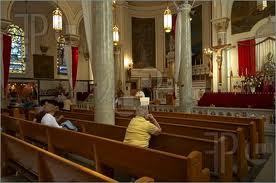
Catholic church praying

I remember as a kid, being brought up in the Catholic church, the peaceful quiet times I spent in the church–praying. The above picture brought back memories of those times.  I also remember the church doors being open many times during the week, both day and night. Today, as I look back upon the customs of our friends , the Catholics, I wonder who it is that has the real  light concerning this ” house of prayer” injunction. We as  SDA  claim to be those obeying the  Lord’s Commandments and teaching His prophecies but are we lacking in an overlooked  declaration of the Lord concerning the purpose of His house? Let us look into this most important aspect of His house of prayer.

As we  come together each and every Sabbath into the house of the Lord we in fact walk into His house of prayer. In Scripture  we read,  “I will bring them to my holy mountain of Jerusalem and will fill them with joy in my house of prayer. I will accept their burnt offerings and sacrifices, because my Temple will be called a house of prayer for all nations.”(Isaiah 56:7)

And our Lord specifically said, “He said to them, the Scriptures declare, ‘My Temple will be called a house of prayer,’ but you have turned it into a den of thieves!” (Matt 21:13).

Recently a church friend had stopped by for a bible study and she had mentioned how the Catholic church keeps it’s church doors opened for “prayer” and she wondered why we aren’t. This got me thinking –what’s going on with our own church in this regard?

As SDA we come together every Sabbath to study and worship in His house. We have services for roughly 3 to 3 and a half hours each Sabbath. But what about praying in His house? To a large extent it doesn’t exist! This is the sad fact. At no time throughout the whole week do we ever have our church doors open to allow us to enter to silently pray to our Lord.

Is this not a gross oversight to us as Seventh Day Adventists?

Ellen White explains, “”Bible religion is not made up of theological systems, creeds, theories, and tradition, for then it would not remain a mystery. The worldly would understand it through their own natural abilities. But religion, Bible religion, has a practical, saving energy, elements proceeding wholly from God—a personal experience of God’s power transforming the entire man.” (Manuscript Releases Volume Sixteen, page 236.)

And what could be one of best “personal experiences” than to be in God’s house praying? A while back a close friend of mine had been involved in a personal and emotional experience with her parents. She was left distraught one morning and wanted to drive down to the local church (SDA) to go inside and pray. She was to find out that no such possibility existed. Nothing was open.

We understand that today with the increase in crime and homelessness, the church is vulnerable to some mischief if it were to be left unguarded. However, is not our church able to open at least a few hours during the week for those who would want to be in His house to pray? If our Lord said that His house is a house of prayer, then would it not be a great and special thing to pray in His house to Him?

In the days of old His house was a true sanctuary and the believers felt His presence and were likely to be there even into the night. “Behold, bless the LORD, all you servants of the LORD, who by night stand in the house of the LORD! Lift up your hands in the sanctuary, and bless the LORD!” (Psalms 134:1-2)

Then we see that even in Jesus’ day there were some who stayed in the temple praying. ” Then  she lived as a widow to the age of eighty-four. She never left the Temple but stayed there day and night, worshiping God with fasting and prayer.” (Luke 2:37) As SDA we often criticize the Jews of old as being wrong in many aspects but we certainly have much to learn from them in the — house of prayer custom.

Today during our services we have a short and formal “garden of prayer”. It’s usually 3 to 5 or 6 minutes. And we listen to someone else pray rather than spending quality time praying to the Lord and King ourselves. But are these few formal minutes  a fulfillment of being His house of prayer? Far from it!

We are woefully in need of revival and reformation in SO MANY areas and this house of prayer issue is right up there near the top in importance. This is something that should be looked into and changed. Our worship has become a timed scaled model of cold formalism.

In reviewing information for this week’s post I happen to come across a fellow church goer’s personal testimony as to the rigid and cold services he found. Although he belongs to a different church and religion, look at how similar his experiences are to what we see in the SDA.

In explaining why he quit the church, he says—

“I often found the worship services to be very structured and rigid, and therefore predictable. Here’s a typical Sunday worship service at OWC:

  • The choir sings
  • Opening prayer
  • The choir sings again
  • The congregation sings
  • The scripture passage is read
  • The choir sings again
  • The sermon is preached
  • Closing prayer
  • Congregation sings again
  • Tithes and offering
  • Benediction (always by a pastor)
  • Lord’s Supper (once a month only!)
  • After each service, people typically gather into their own little circle of friends (ie., “cliques”).
  • After socializing, most people either go home; have lunch with their friends; or go to Sunday school, and… that’s about it!

Notice how there is:

  • no time for group prayer
  • no time for sharing
  • no time for getting to know one another
  • no time for spontaneity and for the Holy Spirit to take part in the service
  • no time to hear testimonies or sermons by people in the congregation (mostly)

In other words, there is no time for true fellowship. This lack of involvement by people in the congregation also serves to deprive them of using their gifts and talents, thereby denying them their share in the priesthood (according to the NT, all believers share in the priesthood 1 Peter 2:9).”

____________________________________________________

This should awake us to the fact that as SDA, and claiming to be the “remnant” people of God, are we really showing the world we are? What difference do we see in our worship service  as opposed to the Sunday keepers above? From the description above , we see little except the day of service. Both them and us leave out true quality prayer before, during,  or after service. We seem to forget that the Holy Spirit is alive and should be allowed to “move” the people during the service, just like the early Christian church.  The people should be allowed to pray in His house without distractions.

One of the most practical ways we could change this error, is to open the church from say, 8 am to 9 am for early morning prayer. Then those who value the privilege of being in His house to pray–can do so.

In closing we have the promise that soon “all” things will be restored and that even our true worship and prayer in His house will be brought back to its beauty, glory,  and holiness. LET US PRAY FOR THIS.

The Tithe Truth Revisited (Part 2 of 2)

November 23, 2013

weight scales-2

In continuing our second part of the post, we shall now look at the  references in support of not paying tithes on the Sabbath and particularly in the sanctuary on the Sabbath. At the end, we’ll weigh it out in a final summary.

k) 2 Kings 12:9-10

 “Jehoiada the priest took a chest and bored a hole in its lid. He placed it beside the altar, on the right side as one enters the temple of the LORD. The priests who guarded the entrance put into the chest all the money that was brought to the temple of the LORD.Whenever the chest became full, the court secretary and the high priest counted the money that had been brought to the LORD’s Temple and put it into bags, and told the money that was found in the house of the Lord.”

Comment – As far as we know, this is the first Scripture that gives account as to how the money was collected (“a chest” with a bored hole in lid). This supports the conclusion that no collections were taken, rather this chest container suggests a depository for “free-will” offerings. Prior to this verse in 2 Kings 12:4 we find further evidence of free-will offerings, “..and all the money that a man purposes in his heart to bring into the house of the Lord.” No support for Sabbath collections nor sanctuary collections.

No points for Sabbath collections. Point against sanctuary tithe collection.

 L) 2 Chronicles 24:8-11

 “At the king’s command, a chest was made and placed outside, at the gate of the temple of the LORD. A proclamation was then issued in Judah and Jerusalem that they should bring to the LORD the collection that Moses the servant of God had required of Israel in the wilderness.All the officials and all the people brought their contributions gladly, dropping them into the chest until it was full.

Whenever the chest was brought in by the Levites to the king’s officials and they saw that there was a large amount of money, the royal secretary and the officer of the chief priest would come and empty the chest and carry it back to its place. They did this regularly and collected a great amount of money.”

Comment – This supports the collections being received outside of the sanctuary. No support for Sabbath collections as it is inconclusive. We should note that back in those days the Temple was frequently open for prayer and such and that the chest was there most any day of the week for someone to come and donate.

No points for Sabbath collection. Point against sanctuary tithe collections.

m) Nehemiah 12:44

On that day men were appointed to be in charge of the storerooms for the offerings, the first part of the harvest, and the tithes. They were responsible to collect from the fields outside the towns the portions required by the Law for the priests and Levites. For all the people of Judah took joy in the priests and Levites and their work.”

Comment – We see that “storerooms” was where the money was kept for the tithes. The collection occurred from going to the “fields outside the towns”. Logically we can deduct no collections came from within the sanctuary. No proof for Sabbath day collections as well.

No points for Sabbath collection. Point against sanctuary tithe collections.

n) Mark 11:15-16 –

On reaching Jerusalem, Jesus entered the temple courts and began driving out those who were buying and selling there. He overturned the tables of the money changers and the benches of those selling doves, And he would not allow anyone to carry anything through the temple.”

Comment – This statement is quite strong and emphatic. The Temple courts were not to have merchandising within it. Which would be similar to our churches having books, cd’s and other merchandise for sale in the foyer before, during or after service. Further, Jesus put a restriction on its practice — “would not allow anyone to carry anything through the temple”. One can clearly deduct that if this was not allowed in the “Temple courts” how much more was it not allowed within the Temple itself?

Today in the “temple”, during services we sometimes see the asking for subscriptions, asking for donations for services (such as church improvements) and other monetary church “business”. Also the promoting of merchandise (Dvd’s Cd’s books, etc.) within the sanctuary as well as elaborate requesting of funds and raising financial goals. Clearly this is condemned by the King Himself. No evidence this was Sabbath or not.

No points for Sabbath collection. Point against sanctuary collections.

o) 1 Cor. 16:2

Now about the collection for the Lord’s people: Do what I told the Galatian churches to do. On the first day of every week, each one of you should set aside a sum of money in keeping with your income, saving it up, so that when I come no collections will have to be made.”

Comment –  We see that Paul clearly implies that no collections are to occur on the Sabbath or in the sanctuary. This also shows that because the “Christians” being the minority and off-shoot sect, they had a new and different way of collecting donations or tithes, apart from the wide tradition of Jewish temple collections.

The traditional storehouse (Jewish Temple) was no longer the place where the Christians paid their tithes because it no longer had God’s present Truth. Further evidence of this can be found in Acts 4:34-35. “For all…brought the proceeds of the things that were sold, and laid them at the Apostles feet; and they distributed to each as anyone had need.”

Point against Sabbath collection. Point against sanctuary tithe collections.

p) Desire of Ages, p.614

…He commended the widow who brought her offering for God’s treasury. Man’s abuse of the gift could not turn God’s blessing from the giver.

Jesus was in the court where were the treasure chests, and He watched those who came to deposit their gifts. Many of the rich brought large sums, which they presented with great ostentation. Jesus looked upon them sadly, but made no comment on their liberal offerings. Presently His countenance lighted as He saw a poor widow approach hesitatingly, as though fearful of being observed.

As the rich and haughty swept by, to deposit their offerings, she shrank back as if hardly daring to venture farther. And yet she longed to do something, little though it might be, for the cause she loved. She looked at the gift in her hand. It was very small in comparison with the gifts of those around her, yet it was her all.”

Comment – We see evidence that the place for the money collection was in “the courts” not in the sanctuary. We don’t have enough evidence to say whether it was collected on Sabbath or other day.

No points for Sabbath collections. Point against sanctuary tithe collections.

RH, Aug.29, 1878

We solemnly promise, before God and to each other, to conscientiously pay to the Systematic Benevolence Treasurer a tithe of all our income, to be paid on the first Sunday of each one of the four quarters of the year; namely, the first Sunday in January, the first Sunday in April, the first Sunday in July, and the first Sunday in October.”

 Comment – This is very clear as to the day of paying tithes. This was an agreement made by the SDA founders  and sent to the conference churches as the adopted practice and rule.

 Point against Sabbath collection. Point against sanctuary tithe collections.

 r) Adventist Review 3-94

 “After the plan of paying tithes was presented to the believers, Maud was usually one of the first in line when the collector came by on Sunday mornings.”

 Comment – Obvious statement supporting both Sunday collection and no sanctuary collection.

 Point against Sabbath collection. Point against sanctuary tithe collection.

 s) RH, Feb.4 1902

 “The directions given by the Holy Spirit through the apostle Paul in regard to gifts, present a principle that applies also to tithing: “Upon the first day of the week let every one of you lay by him in store, as God hath prospered him.” Parents and children are here included.

Not only the rich, but the poor, are addressed. “Every man according as he purposeth in his heart [through the candid consideration of God’s prescribed plan], so let him give; not grudgingly, or of necessity: for God loveth a cheerful giver.” The gifts are to be made in consideration of the great goodness of God to us.

And what more appropriate time could be chosen for setting aside the tithe and presenting our offerings to God. On the Sabbath we have thought about His goodness. We have beheld His work in creation as an evidence in His power of redemption. Our hearts are filled with thankfulness of His great love. And now, before a toil of a week begins, we return to Him His own, and with it an offering to testify our gratitude.”

Comment- EGW uses Paul’s specific day “first day of the week” Sunday as the day to set aside tithes and offerings. She then says it’s the day for “presenting our offerings to God.” In the comment “before the toil of a week begins we return to Him His own..”, some  could interpret it to mean sometime Saturday “Sabbath” yet if one uses this interpretation, then we must cancel out her previous statement of presenting our offerings on Sunday “first day of the week”.

She cannot be saying Sunday and then saying Saturday as well as it would be contradictory, pointless and make no sense. We should concede that the “before the toil of a week begins” comment is referring to either Saturday evening or most likely Sunday. Logically it would be the latter.

Point against Sabbath collections. Point against sanctuary tithe collections.

t. Jezreel Letter, no.3, p.1-3

Truth challenges you, Elders, to point out wherein the Bible teaches either by word or by example that the Sabbath and the church were made for raising goals, for auctioning, for selling literature and for taking subscriptions. The Bible does not teach or recommend even a plate collection (a custom which Rome originated) in Sabbath services, much less merchandising in the presence of God. All the Bible recommends is a container for free will offering placed somewhere in the church premises. It was into such “a treasury” that the widow, while entering the temple, placed her two mites.”

 Comment – Obvious is the point about the practice of collections in the sanctuary as not Biblical (Roman custom). The specific point is made that the Bible “recommends” a container for free-will offering, not the requesting for tithes and passing around the collection hat, plate, box or bag. Although it mentions, “the Bible does not teach or recommend even a plate collection IN Sabbath services”, it’s inconclusive on “day” of paying tithes, or if a free-will deposit could be made somewhere else on church grounds.

 No points for or against Sabbath collection. Point against sanctuary tithe collections.

 u.Jezreel Letter, no.9, p.8

Look and see what a difference there is between God’s method for supporting His work, and the Roman system that is now carried on by the church: plate-passing, high-powered speeches, Big Day, Book Day, high pressuring, campaigning, selling, auctioneering, Harvest Ingathering, birthday offerings, Christmas-tree hangings, baby weighings, Dorcas sales, investment funds, and what not! As none of these squeezings are Biblical, and as all of them are Pagan in origin and condemned by the Scriptures, they could not possibly be considered freewill offerings. Search and see.

Instead of Sabbath-keeping the day is devoted to money raising, and instead of a house of worship, the church is turned into a den of thieves –disgusting to observers, and most discouraging for a member to invite a friend or a neighbor to a church service. Is there any wonder that God does not now bring many into the church (“Testimonies,” Vol. 6, p. 371)?

It was this sort of thing that aroused Luther to action as he saw the priests living in luxury by exploiting the people’s conscience and by making the poor poorer. True worship and God’s plan for supporting the work must now be restored.If there is any revival and reformation needed in any line it is certainly needed in this line, and no one is excused from having a part in it if he but takes to heart the Word of God and if he refuses to comply with the afore mentioned abominations.

Comment – The emphasis is placed on the point that the collections(plate passing) of tithes is from the “Roman system” and not Biblical. Later this act is called an “abomination”. But there is no real statement, one way or the other as to the “day” for paying tithes.

One could argue that by the statement, “could not possibly be considered free will offerings”, that if the “free will offerings” were brought in on the Sabbath outside the sanctuary it would be acceptable.

No point for or against Sabbath collections. Inconclusive. Point against sanctuary tithe collections.

  Summary  

In reviewing the whole report we can see the historical practice of the Biblical fathers as clearly having no temple collections on the Sabbath. What we find is that perhaps there was a practice of bringing the tithes to the services on Sabbath but they were placed into a collection box or chest. This was a “free-will” offering, brought in,  as opposed to today’s  requestings by church leaders on the Sabbath and then collected in sanctuary.

So we see strong evidence, a very weight-full position, that the practice of tithe collections were very different from what is the tradition practiced today with our SDA church. The custom of Sabbath collection within the sanctuary has no basis  in the Lord’s Scriptures. Additionally,  plate passing, bag passing, hat passing, box passing within His sanctuary has not one iota of evidence from Scripture.

Next, in reviewing our SDA church history we find some points that should be noted. First, the corporate body came together in 1859 and established its first “Systematic Benevolence” plan of paying tithes as a church body. A general outline that was to be the practice. And in 1878 it was re-confirmed with slight changes.

However in about 1885 we see that the church leaders had changed their stance on Sabbath collections as noted in the General Conference 1885 meeting. We can speculate that there were practical reasons for this change. The homes and abodes back then were often spaced far apart from one another. And as the mode of transport was the horse buggy this took quite a time consuming task to go to the many members. Plus some no doubt were out and about during the collectors visit. So after the many years of struggle in keeping this plan, it appears for logistics reasons an adjustment had to be made.

But of importance is Ellen White’s last known statement on our subject. In 1907 she said, “Let our people avoid the passing of the contribution boxes, even if it becomes a much more difficult matter than it now is to raise money for foreign missionary work.

It would be well if our brethren and sisters would consider the advisability of laying by during the week their offerings for missionary work. As they call to mind the blessings and mercies that god is affording them, let them put a thank offering in an envelope. These envelopes could be presented on the Sabbath, when it could be stated for what purpose they are intended…

The sacredness of the Sabbath could be in no way violated by such gifts, and the results would be for good… My brethren and sisters, try this method. Let there be no collections taken on the Sabbath, but let praise and thank offerings be made.”

In concluding our SDA history of tithe collection we see that circumstances caused division in customs. But it shows that though their appeared Sabbath collections, the issue of collection within the sanctuary is not as clear. The evidence is very weak for it. And often clearly against it, both in the “for” and “against” references. To summarize, we see that Sabbath collection occurred within our early history of SDA church, but sanctuary collection remains a clouded and much more weak issue.

As many of us are aware, and as we’ve shown through out our many posts, the Elijah message is God’s final message to us as the SDA church, individually and corporately. So logically if we are to believe in His messenger, we must put the final weight of balance of this issue in what was said by His “Elijah”. The purpose of Elijah was to “restore” all things, meaning an understanding of the rights and wrongs of our practices, doctrines and faith.

And this issue, surely the Lord knew would come up in a contentious and public way. The Elijah prophet did not skirt his duty in this regard he delivered the final words on this subject, clear and unmistakable. He said, “If there is any revival and reformation needed in any line it is certainly needed in this line..”

In closing, our all-seeing Lord has made  “outs” for us. But it’s only good if we take it. Today we have the efficient mail system, where we can mail in our tithes. We also have the church website, where often they have a “donate” button to click and send it in electronically. May the Lord guide you to do the right thing in this matter. As the Elijah calls this an “abomination” do we snub the Lord’s last pleading word to us? God forbid!

Note – As we hope that you are blessed by this study, it should be remembered that just as important as the day/practice of paying tithes,  the true “storehouse” issue is restored by Elijah as well. For this study see — https://godsloveandlaw.com/2012/09/22/offerings-and-tithes-part-1-of-2/

The Tithe Truth Revisited (Part 1 of 2)

November 16, 2013

tithe paying old testament

A few weeks back we did a post called, ‘The SDA’s Original “Systematic Benevolence” (listed under tithes and offerings). We posted on the original plan adopted by the SDA in 1859. As the Lord so often does, and as we continue on the path for truth, we are revealed more and more of His word and truth as we search. The “Spirit of Truth” is guiding, if we take the humble position that sometimes we can be corrected.

Recently I received an email from a brother of mine, and fellow SDA member. He pointed out that the position taken in the post was not entirely correct. He backed in up with references from the Spirit of Prophecy.  We began a series of email exchanges and looked deeper into the issue.

Many times we are so convinced of a point that we will try to sustain our position, even against some clear evidence against it. Such was my case. We had made the point that the SDA practice within the church since 1859 through 1915, EGW’s death, was that collection of tithes did not occur, for the most part,  on the Sabbath within our churches.

But as I  viewed  more and more of the references my brother showed me, it started me thinking that I should look much deeper into the subject. It was a case where I was believing that our founders made a tithe plan and thus they would keep their word and practice  come what may. I assumed wrongly. And there was reasons for this change , which in hindsight, was quite logical and practical.

I found these two quotes that are quite applicable here.”We cannot hold that a position once taken, an idea once advocated, is not, under any circumstances, to be relinquished. There is but One who is infallible–He who is the way, the truth, and the life.” (Testimonies to Ministers, p. 105)

“Do not read the word in the light of former opinions; but, with a mind free from prejudice, search it carefully and prayerfully. If, as you read, conviction comes, and you see that your cherished opinions are not in harmony with the word, do not try to make the word fit these opinionsMake your opinions fit the word. Do not allow what you have believed or practiced in the past to control your understanding. . . .Find out what is written, and then plant your feet on the eternal Rock.” (Messages To Young People p 260)

The main basic point has not changed–that our Lord does not want Sabbath collection of tithes, in the sanctuary. The truth of this situation has been restored by the Elijah prophet, this we are sure and we must abide. It does appear that it was acceptable to have a “collection box” placed somewhere on the church (temple) grounds, and that the people could give a free-will offering before entering the temple.

Some may ask– “Why is this important? What’s the big deal if we pay our tithes on the Sabbath and in the sanctuary?” It’s because  if we find out that this is an abomination before the Lord, we cannot be sealed in the forehead. This, I would say is worth looking into! Remember that only those who turn away from the sins in the church and “sigh and cry” about them will be sealed–no others. This point is confirmed by all three divine writings, Scripture (Ezek. 9, EGW- Testimonies for the Church, vol. 3, p.267, and the Elijah message- Shepherd’s Rod vol. 1 and 2)

So I embarked on a study which took several days and hours and sent it to the brother. What I’d like to do is show this study now. It is a more complete picture of what the historical evidence showed in tithe collection within our SDA church and our fore-fathers in the Bible.

                       The Tithe Report                

Contents

1 Scripture Promises                              

2 Purpose of Study                                    

3 Ellen White’s Study Counsel                  

4 Applying the Rules                                 

5 Positions taken                                      

6 References used                                   

7 References discussed                         

Summary                                              

Conclusion                                               

1 – Scripture Promises                                   

The Lord promises us two promises that are particular to our present study. 1) He shall guide us into all Truth (John 16:13) 2) If we do His will, we shall know what is correct doctrine (John 7:17).

Let us pray first and foremost for His guidance and our desire to know Truth above anything else. If we find It, let us rejoice and not be ashamed if we have side-stepped It or ignored It. The Lord said “I am the way, the Truth, and the life..”(John 14:16) (From here on I will capitalize the word Truth as it means Jesus)

We have the solemn warning that if we do not love the Truth (Jesus) we shall not make it to the promised land. “He will use every kind of evil deception to fool those on their way to destruction, because they refuse to love and accept the Truth that would save them.” (2 Thes. 2:10)

2 – Purpose of this study

As mentioned above we have as our foremost goal and desire in this study to know what is the Truth of tithe paying. Specifically three areas of tithe paying. 1) What day is proper to pay the tithes per the inspired writings? 2) Should the tithes be paid in the sanctuary on Sabbath? 3) Should the tithes be paid on Sabbath in a location apart from the sanctuary?

3 –Ellen White’s study counsel 

a) “Every man who bears the message of Truth to our churches must do his duty by warning, educating, rebuking. Any neglect of duty which is robbery toward God means a curse upon the delinquent.” (Special Test. For Ministers and workers, no.7, p.22)

b) “Those who desire to doubt will have plenty of room. God does not propose to remove all occasion for unbelief. He gives evidence, which must be carefully investigated with a humble mind and teachable spirit, and all should decide from the weight of evidence. (Test. Vol.3, p.255)

c) “The unbelief that demands perfect knowledge will never yield to the evidence that God is pleased to give. He requires of His people faith that rests upon the weight of evidence, not upon perfect knowledge.” (Test. Vol. 3, p.258)

d)“The evidence given one day, if rejected, may never be repeated.” (Ibid, p.258)

e) “Men, women, and youth, God requires you possess moral courage, steadiness of purpose, fortitude and perseverance, minds that cannot take the assertions of another, but which will investigate for themselves before receiving or rejecting, that will study and weigh evidence, and take it to the Lord in prayer.” (Test. Vol. 2, p.130)

f)“The opinions of learned men, the deductions of science, the creeds or decisions of ecclesiastical councils, as numerous and discordant as are the churches which they represent, the voice of the majority—not one nor all of these should be regard as evidence for or against any point of religious faith. Before accepting any doctrine or precept, we should demand a plain ‘Thus saith the Lord” in it’s support.” (Great Controversy. p.595)

g) Error could not stand alone, and soon would become extinct, if it did not fashion itself like a parasite upon the tree of truth. The traditions of men, like floating germs, attach themselves to the truth of God, and men regard them as part of the truth.. And as traditions pass on from age to age, they acquire a power over the human mind. But age does not make error truth.”—Letter 43, 1895, cited in SDABC, vol. 5, p. 1094.

h) “If you had made God’s word your study, with a desire to reach the Bible standard and attain to Christian perfection, you would not have needed the Testimonies. It is because you have neglected to acquaint yourselves with God’s inspired Book that He has sought to reach you by simple, direct testimonies, calling your attention to the words of inspiration which you had neglected to obey, and urging you to fashion your lives in accordance with its pure and elevated teachings.’”(Test. vol. 5, p.665)

4 – Applying the above rules to our study

From the above inspired counsel we gain at least 3 important guidelines to come to a clear conception of what is Truth in our matter. 1) We must carefully gather the evidence for and against, then weigh the total matter. Then accept the position in favor of the weight full position. 2) The “Bible standard” is what Ellen White counseled us to obtain. Her writings are to be judged against the Bible, not vice-versa. 3) The Truth is not to be judged and followed by how many are siding with a certain precept or doctrine. Traditions are not always an indication that the doctrine or precept is Truth.

Evidence of Truth shows that in history, the Truth stands with the few, our Lord being the perfect example (Thousands against – few for Him). Although a tradition is carried among His people, this is not proof the precept or doctrine is true and from God. The Lord Himself scolded the Jews for the many man-made traditions they had and yet the majority of people sided with the leaders and were convinced the Lord was wrong, yet they were wrong.

5Positions Taken

Some take the position that the tradition within the SDA church of collecting tithes within the sanctuary in Sabbath services on Sabbath is acceptable to God. The support of this position comes from Ellen White quotes and because it is our current tradition. 

Others take the position that this tradition is not from God’s historical plan, not Biblical, and is not acceptable to Him. The practice has been man-made. Or more precisely, was created by the adversary and is without Scriptural basis.This support comes from Scripture and the Elijah message. 

6 – References used

For                                Against

a. RH, March 2, 1905      k. 2 Kings, 12:9-10

b. RH, Nov.1, 1898          L. 2 Chronicles, 24:8-11

c. Ah, p.482-483             m. Nehemiah, 12:44

d. PH, 0929                    n. Mark 11:15-16

e. PH, 129, p.2               o. 1 Cor. 16:2

f. 4 Bio, Ch. 10, p.105     p. Desire of Ages, p.614

g. 1912 letter from         q. RH, Aug.29, 1878

W.C. White   

h. Sabbath School Worker,  r. Adventist Review, 3-94

April 1885  

I. 1916 letter from W.C. White    s. RH, Feb.4, 1902

j. EGW, Manuscript 176, 1907

(Some believe that Mal. 4:5 is a prophecy fulfilled within the SDA church, and included are Victor Houteff applicable quotes.)

t.Jezreel Letter, no.3, p.1-3

u.Jezreel Letter, no.9, p.8

7 – References discussed

We will show each reference and then breakdown the clear points made therein by a comment section below each. Then we’ll add or subtract that reference either for or against the positions taken.

a) RH, March 2, 1905    “Elder W.W. Simpson had been holding tent-meetings in the heart of the city of Los Angeles during a large part of the summer and the large tent, then standing on Grand Avenue and Seventh street, was being use by the church for their Sabbath meeting. Soon after our arrival, letters were sent to our people in the neighboring churches, suggesting that a general meeting be held at the Los Angeles on Sabbath and Sunday. In response to this, two or three hundred brethren and sisters came in from surrounding towns and these, with the believers in the city, filled the large tent on Sabbath morning. The Lord helped me to speak to this congregation of over thousand of souls, all of whom seemed much interested. At the close of my discourse, a collection amounting to seventy-five dollars was taken up for the work among colored people of the Southern States.”

Comment- This quote can be seen as inconclusive because it says she speaks, but it does not say it was Sabbath or Sunday, as the event covered both days. But one can make the argument that after saying the tent was filled on Sabbath morning she spoke. The collection occurred after whatever day she spoke, this is sure.

Further it is noted that this was not in a “sanctuary” setting per se. It was a “tent” gathering, similar to a traveling road show in those days. If we believed that these tent meetings held the sanctuary, it would be similar to saying one of Doug Batchelor’s or Mark Finley’s travelling bible seminar meetings held within an auditorium,  in a city,  was where one of the Lord’s sanctuaries was.

Point for Sabbath collection based on a further reference (I). No points for sanctuary tithe collections.

b) RH November 1, 1898 Par 2    There was a large attendance at our meetings on SABBATH June 4. Besides the families of the Avondale church, there were about forty present from Dora Creek, making a congregation, old and young, of over two hundred. The weather was excellent, and about thirty took their dinner under the large gum-trees near the church. This was the last Sabbath of the week of prayer, and the time appointed for the bringing in of the annual offerings for missions.”

“During the week, envelopes had been distributed, in which the gifts to the missions might be enclosed: and on the envelope was a place for the name of the giver, and for the reference to a Scripture text expressing the thought accompanying the gift. A Similar provision was made for gifts to the school.”
                                                                  Comment- This quote appears to confirm a Sabbath collection. However there is not the slightest indication that the collection occurred within His sanctuary. There does present an argument that the collection was held outside. Perhaps in a park like setting “under the gum-trees near the church” after dinner, or under a tent as the meetings were so often held. This is speculative.

Point for Sabbath collection, no points for within His sanctuary.

c) Ah p.482-483     A tree laden with offerings is not Sinful.–Let not the parents take the position that an evergreen placed in the church for the amusement of the Sabbath school scholars is a sin, for it may be made a great blessing. Keep before their minds benevolent objects”

Provide Innocent Enjoyment for the Day -Will you not arise, my Christian brethren and sisters, and gird yourselves for duty in the fear of God, so arranging this matter that it shall not be dry and uninteresting, but full of innocent enjoyment that shall bear the signet of Heaven? — “(All) should bestow their gifts and offerings proportionate to the means with which God has entrusted them. Let there be recorded in the heavenly books such a Christmas as has never yet been seen because of the donations which shall be given for the sustaining of the work of God and the up building of His kingdom.”

Comment – In the top paragraph it is seen that obviously there can be “offerings” placed upon the tree. However in that paragraph there is no evidence that the offerings were placed there on Sabbath, Sunday or any other day.

Additionally in this quote we see that it appears that the tree where the offerings are placed isn’t specified as to what location of the church the tree is located. “In the church” can mean sanctuary, foyer, adjacent room, or?. One can only speculate. Bottom paragraph gives no indication on the specific day or if in sanctuary to ‘bestow their gifts”.

No points for Sabbath collection. Inconclusive. No points for sanctuary tithe collections

d) PH 0929     The Sabbath meeting will be like meat in due season; for all will bring precious offerings to the Lord.”

Comment – This appears conclusive that a collection will occur at the Sabbath meeting”. However no evidence as to collecting within the sanctuary. Speculative.

Point for Sabbath collection. No points for sanctuary tithe collections.

e) PH 129 p.2      ….”Urge the members to make the subject a matter of family study and prayer during the week, and then bring their gifts the following Sabbath. The dedication of the gift be a season of prayer will bring a blessing to the church. We pray that this may be more than an ordinary collection. This gift would be a beautiful one -large in proportion to the need.

Comment – This appears conclusive that a Sabbath collection will happen “the following Sabbath”. Are they to “bring their gifts” to be deposited or will a collection take place? We don’t know. No indication it’ll be collected in sanctuary.

Point for Sabbath collection. No points for tithe collection in sanctuary. Inconclusive.

f) 4 Bio, Ch 10, p.105     “It was thought, as the brethren counseled together, that the time had come when Mrs. White could return to Australia, by way Auckland. But just then a telegram came informing them that the missionary brigantine Pitcairn (A hundred-foot sailing vessel built in 1890 for use as a missionary ship in the south pacific, PAID FOR BY SABBATH SCHOOL OFFERINGS.”)

Comment – This appears to confirm Sabbath collections had previously occurred, hence the “paid for” comment. No indication offerings were collected in the sanctuary, foyer, adjacent building, court-yard

Point for Sabbath collections. No points for collections in sanctuary.

g) 1912 Letter from W. C. White     The question of proper Sabbath observance is one about which Mother has often spoken. She has often appealed to our people to make the Sabbath a day of worship, devotion and communion with God, and to sacredly guard it from secular business. Also during the years she has often pointed out that bringing of gifts to the Lord is a very important part of worship, and as a part of worship is proper for the Sabbath.” (EGW Estate, March 20, 1957 file)

Comment – This is evidence of support from EGW that approves “gifts” brought to the worship service. As the gifts are not specific, we can assume that money is included. One cannot conclude if the gifts are brought in and deposited or collected within the sanctuary, foyer, at entrance, or wherever. Speculative.

Point for Sabbath collections. No points for collection within the sanctuary.

h) Sabbath School Worker, April 1885

Question – “Why is it right or proper to take up collections for the Sabbath-school on the Sabbath more than for any other branch of the work?”

Answer – “We do not believe it to be appropriate to pass around the hat in the ordinary way of taking up a collection. There are quieter ways of better accomplishing the desired result. In the supply department is noticed a cloth-lined envelope, the use of which seems to us to be the simplest plan yet proposed.

The scholars bring their contributions, and at the appropriate time place them in the envelope, the contents of which is not counted by the teacher till after the Sabbath.

For some schools that might desire to be even more quiet in this work, we have secured small envelopes for individual scholars. During the week the scholar can put his contribution in the small envelope, and then when he comes to the school it can be dropped into the larger one. We rather like this way ourselves.”

Comment – We gleam some specific information in this SDA advisory publication in 1885. The first is that they say it is not “appropriate to pass around the hat” during the Sabbath school collections. The comment about the hat passing does suggest that there was a practice (we don’t know the extent) of sanctuary hat passing for tithes in some of the churches. 

But they advise completing the donation in the envelope and then it can be “dropped” into a larger container, which would assume this would not be in the sanctuary. Also it’s noted that the contents are “not counted” until after the Sabbath. A practice that is ignored today within the SDA church. We find three specific counsels on tithing concerning Sabbath school within this reference.

Point for Sabbath collections. No points for sanctuary tithe collections.

I) 1916 Letter from W. C. White    Dear Brother, … She has never taken the position, so far as I understand, that there shall be no collections on the Holy Sabbath. On the other hand, she herself has called for funds for various missionary enterprises, on that day; and it is a matter of common knowledge that she has ofttimes published in the Review and in other periodicals, stirring appeals to our people to make donations on certain occasions, often on Sabbath days, for missions, and for other worthy missionary enterprises, including the Colored work in the South; the Orphans; the religious Liberty Work; our Educational work; the relief of Skodsburk Sanitarium and of the Christiania publishing house, etc, etc.—all Sabbath collections. She has on Sabbath days called for gifts to help establish the work in Portland, Maine.

.I understand that scriptural teaching has been written on by several. I am enclosing one herewith, which you may keep.”

During the General Conference held Nov. 18 to Dec.6, 1885 (as reported in the year-book for 1886), the committee on Resolutions presented the following report, which was accepted:

9. RESOLVED? That we hereby indorse the standing rule of our Sabbath-school Associations in regard to taking offerings on the Sabbath, for the following reasons: (1) It trains our young to the habit of giving. (2) If appropriated, nor merely for school expenses, but, as is now being done in some places, in part for missionary work, it cultivates a missionary spirit in the children. (3) It is in harmony with the Lord’s will as expressed in the law, when more offerings were made on the Sabbath than any other day.*** (4) it is in harmony with the light given us as a people. And–

10. RESOLVED? That the same principles apply to the subject of donations on the fourth Sabbath of the month, which day is devoted to the missionary work; and we recommend that they be so taken.”

Comment – Confirmation that shows EGW supported Sabbath collections. Appears to be a Conference guideline as well in 1885. No mention is made as to the place of collections. The sanctuary, the foyer, the connected buildings, drop box at entrance, or any other various locations cannot be excluded as the collection spot. Speculative. Note— the ? after the RESOLVED is original and can’t be readily explained.

*** – This statement is speculative and needs clarification and support from Scripture. A sacrificial offering, grain offering or fruit offering would be quite different from a gold, silver or copper offering (ie. Money). We cannot find any evidence of such money “offerings” being made within the sanctuary on Sabbath in the Old or New Testament.

Point for Sabbath collections. No points for sanctuary tithe collections.

j) EGW Manuscript 176, 1907

Question – Should we take up Collections on the Sabbath?

The question has been brought before me, Shall we take up collections on the Sabbath? The occurrence which brought up this question was that of taking up a collection to purchase an organ for the church. I replied that I would not advise this being done.

When collections are taken on the Sabbath for foreign missionary work, it is that the gospel may be given to those who are in darkness. This is genuine missionary work, and often these collections could not be taken up so fully at any other time. To gather these offerings could not be called transgression of the Sabbath.

But if this is to open that way for taking up of contributions for such purposes as buying of instruments of music, then I would advise that it be discontinued… Let our people avoid the passing of the contribution boxes, even if it becomes a much more difficult matter than it now is to raise money for foreign missionary work.

It would be well if our brethren and sisters would consider the advisability of laying by during the week their offerings for missionary work. As they call to mind the blessings and mercies that god is affording them, let them put a thank offering in an envelope. These envelopes could be presented on the Sabbath, when it could be stated for what purpose they are intended…

The sacredness of the Sabbath could be in no way violated by such gifts, and the results would be for good… My brethren and sisters, try this method. Let there be no collections taken on the Sabbath, but let praise and thank offerings be made.”—EGW

Comment – This is one of the last statements written from EGW on our subject. It contains specific advise. Emphasis is placed on the purpose of a collection being important. The goal raising collections seem not supported by EGW. Then we see that additional emphasis is placed on “free-will” offerings as opposed for the requested collections as this statement confirms, “Let our people avoid the passing of the collections boxes..” and “let there be no collections taken on the Sabbath, but let praise and thank offering be made.”

The weight of her statement appears to advise laying aside “during the week” the offerings and presenting them on Sabbath as “thank offerings”, rather than be asked as a corporate body to put in a collection box that is passed around.”

Point for Sabbath collections. Point against sanctuary tithe collections.

This concludes our references “for” Sabbath collections. Next week we will be looking at the references “against” the subject. Then a summary of the subject.

Who was Victor T. Houteff ? (Part 3 of 3)

November 9, 2013

victor-houteff

In our last segment of this 3 part post, we’ll cover some experiences that took place at the camp. Although it first started out as a camp, it grew into nearly a well-built miniature city. Along with several buildings, farming, gardens and other scenic beauty graced the large grounds. But more important than the landscape was the purpose for the camp. Victor developed a sophisticated printing shop to handle the large mailing campaign.

Mt. Carmel miracles and experiences .

Victor and his wife had their living quarters above the printing shop. One night Victor was at rest in the above quarters when he noticed a silence that wasn’t usual.  The printing shop was usually running almost 24/7. The tracts and other literature were printed continually. He was “about his Fathers business”.

So he went down there in his pajamas to inquire what was going on. The workman explained that the machines had apparently broken down and that he couldn’t figure out what was wrong. After hearing this matter, Victor told the man to go on home, he’d take care of it.

The next day the man showed up for work and the machines were back up and working just fine. What happened? One thing was sure, Victor had no mechanical experience.  The only thing that seems possible  is that Victor had prayed that night in the machine room. And the prayer was answered. God’s work could not be stopped.

The next gives light on Victor’s conscientious effort to not let his work be idolized. One day he went up in the chapel to give his usual sermon. As he was speaking, he began to get choked up. Tears began to flow. He felt something deeply and couldn’t control his emotions. This was not normal for him. As the people felt the emotional moment , someone stood up and in an effort to comfort him,  said that he was  a special man and that he was doing a great work for God.

Suddenly Victor’s emotions changed. He looked at the man sternly and said “Don’t you ever call it “my work”, it’s God’s , He’s the one who desires all the credit. Worship Jesus.” The people understood. They knew that he didn’t want even the appearance of any idolization of him or his work. Perhaps he sensed that some at the camp were in need of being reminded of Who it was that was running the show.

We must remember that the Lord had bestowed upon this man the ability to “interpret” Scripture, just as EGW prophesied about the Elijah to come in Testimonies to Ministers, p.475. As such through him came revelations of new light such as the pre-millennial kingdom, the church purification, the hidden prophecies of Isaiah, Daniel, Hosea, Zechariah, Ezekiel and others. So some had viewed him as almost a genius prophet. Victor never denied his work as Elijah but he also never rang his own bell and directly said “I’m the Elijah prophet”. Just like Ellen White also never said “I am a prophetess”.

So from this we see that although gifted he, in no way,  wanted any glory or self-exaltation.

Next we’ll look at the miracle of the kitchen fire and the water dam. Sister Bonnie  Smith, who is now 83 explains–

“The Lord preserved this shack by a miracle one early morning.  Some dish towels that had been left hanging over the stove the night before to dry caught fire when the wood stove was started for the cook to prepare breakfast.  

The roof had been repaired many times with tar so it quickly became one big blaze. (The camp had just bought a 6 door refrigerator and a Holbert bread mixer, they had saved for years to be able to buy these.)  A bucket brigade was begun but it was quickly realized that there was nothing that man could do to stop the fire from burning.  So Brother Houteff said, “Let us kneel down on these rocks and ask God to save our kitchen.”  When we open our eyes after the prayer the fire was out, there was nothing left but smoke.  That was just one of our miracles.”

In April of 1943 the dam almost broke.  The City of Waco sent out 300 CC men to sandbag the breaking area.  They would not go out on the dam because of the danger.  So we fed them and sent them back. 

After they were gone, Brother Houteff, called all the heads of families to gather by the dam. They knelt in the mud to ask God’s protection while they sandbagged the breaking area.

When the prayer was over Brother Houteff said the 
dam would not break, that it was safe to sandbag the area.  They did so for about 36 hours without stopping. 

Our Miracle!!! Our miracle is seen here in this picture.

dambreaks

You will notice all the water being held back by the soft dirt with no rocks visible to hold back that large body of water.  God understood our lack of knowledge and blessed our efforts in making the dam.”

Sister Bonnie Smith is one of only a few people alive today who lived on the camp. She still abides in the message and can recall very clearly the happenings that occurred back in the day.

Next we had the “children’s revolt” story. Back in the late 40’s and early 50’s the big fashionable thing going around the US was the roller skating rinks. Soon some of the kids who lived on the grounds became anxious to have their own rink on the sprawling property. They nudged their parents and later a meeting took place.

Victor and the parents, along with the kids, all had a meeting about what the kids thought was a necessity. Victor let the people speak ,and from sister Bonnie’s account–  he got an ear full! Patiently listening, he took in what they had to say. Victor then coolly said that there was to be no such thing allowed on the property and that any one who wishes, could be free to leave.

He could not allow worldly amusement fashions because the whole purpose, he felt, was to raise the children up to  be a God-fearing peculiar people, not a partaker of worldly passions and amusements. In this he was closely connected with Ellen White. There was farming, building, teaching, studying, learning, and chores that would take up the time. Walking, hiking, woodwork,  gardening and such could satisfy the physical needs.

But after the confrontation, apparently a sizable group of parents and kids decided they couldn’t live without their pleasures and left the camp. But Victor held his ground and knew that as God’s messenger, no distractions could be allowed, as it would surely be seeds that would sprout into further “retreating towards Egypt”, as Ellen would say.

Last days of the camp

Victor lived to be almost 70 years old. He died on Feb. 5, 1955. 27 days shy of the 70th year. As he worked all the way up to his final days, he had a wife named Florence who was his help mate for about 18 years. By all accounts she was a loving supportive wife who also doubled as his secretary. At least that was the image.

Vth marriage

We all remember that sad, sad story of one of the closet people who knew Jesus as He walked this earth–Judas. Although he professed to know the Lord and learn from him, he secretly harbored unrighteous thoughts and deeds. He was a thief in their midst. At the end he fell from grace and betrayed the One he professed to love and follow.

The Victor- Florence story ended similar to that story,  ending in a betrayal. We don’t know what went wrong but as soon as Victor died, she moved to take over. She even called a board meeting the very NEXT DAY after he died. She discussed among other things HER  Future compensation! The body was not even cold yet and there she was holding a business meeting the next day.

You see the devils, led by Satan, were all over this situation. Once Victor died it was their chance for disruption. And there certainly came much disruption soon . And the leader was none other than –Florence Houteff. The man who was supposed to take over was E. T. Wilson, but their meeting excluded him and Florence got her buddies to elect her as the leader of the camp.

Soon she and her cronies began to publish some symbolic news codes. The mixed some of  Victor’s “unpublished” sermon addresses with some of their own messages. Victor had made some of his sermon addresses unpublished and kept them, as the story goes,   in a private file cabinet. No one has ever produced evidence why Victor did not publish them. Although 98 sermon addresses were published, others were not, by his own decision.  Some believe that he was divinely held back.

Regardless, Florence took it upon herself to begin publishing the private addresses. Today, there is a mixed view of these symbolic code news items. They are often referred to as the “new codes”.  Some claim that they are divinely inspired just as the published ones are, others claim that Victor held them back for a reason and one shouldn’t second guess that decision and leave them alone. And should be viewed as “historical” writings as opposed to authoritative divine instructions as the published ones are.

But the BIG blow that came was when Florence and gang made their own prophecy predictions and announced them in the newsletters (sym. codes). They predicted that Ezekiel 9 would occur in April  1959. One thousand people migrated to the camp near the predicted time. The day came and went. Nothing happened! Soon the people were disillusioned. Many soon left the movement and it became the prophesied “Knock out blow” that Victor himself said would happen.

Later in 1963 Florence quit the faith and denounced her husband’s work and even Ellen White! She moved away and disbanded the camp. Thus the end of the camp came to a sad end. Yet the Lord was not done. Even as the apostles were shattered at their King’s death, the movement soon gained life and grew. So too is the story of the work that Victor Houteff started.

“.. if this counsel or this work be of men, it will come to nought: But if it is from God, you will not be able to stop these men; you will only find yourselves fighting against God.”(Acts 5:38-39)

Today we are witnessing a growing interest world-wide.  In fact, the message seems to be spreading faster outside the United States. The message is being put forth out on many fronts. The electronic forums include websites such as Davidian organization websites, Facebook, Blogs, YouTube videos,  Elijah message websites, and other outlets are offering the people a chance to study the message on their own.

Ellen White gives counsel–

“.. beware of rejecting that which is truth. The great danger with our people has been that of depending upon men and making flesh their arm. Those who have not been in the habit of searching the Bible for themselves, or weighing evidence, have confidence in the leading men and accept the decisions they make; and thus many will reject the very messages God sends to His people, if these leading brethren do not accept them.” (Testimonies to Ministers, p.106-107)

We’ve taken a look at some of the experiences of the camp and Victor’s life. Let’s now look at the main core beliefs that were expounded by him.

Core beliefs  

1) The fulfillment of Malachi 4:5.

In His tract called “1950 General Conference Special” Victor lays the case for a prophet to come to the SDA church after Ellen White. Just as EGW never directly said she was a prophetess, so too did Victor not say it directly. Yet upon reading this tract, there is no other conclusion to come to, but that he knew that his role was that of the end-time fulfillment of Mal. 4:5.  (http://www.shepherds-rod.org/Misc/GCS.html

2) Judgment for the living.

He drew from both the Scriptures and Ellen White (Spirit of Prophecy) that there was to be a church purification prior to the Loud Cry. He showed that the Old Testament writers had a large amount of writings showing this end time purification. Tract 3 is called “The Judgment and the Harvest”. It goes into the specifics of this church judgment. http://www.shepherds-rod.org/Tracts/trac003.html

3) Pre-millennial Kingdom

His hallmark teachings are the writings on the pre-mill. kingdom. There are quite a few OT verses that speak of promises given to His people of a kingdom to be set up in the last days. What he was able to do is to lay out all of these writings into a big picture of how it will all take place. http://www.shepherds-rod.org/Tracts/trac008.html

Obviously the above is just the main general teachings, but there is much more, such as instructions in health reform, dress reform and worship (temple) reform. For example,  to view the health reform see the tract called, ” The Entering Wedge”.http://www.shepherds-rod.org/Misc/EW.htm

In closing, if one is to believe in the Lord’s final prophetic prophet application, then one must also conclude that the job of this Elijah is to “restore” all things. Meaning that all the important things we are to know and obey are to be delivered by this Elijah prophet. The teachings are to “straighten us out” in any understanding, idea, or doctrines we have held onto- hence the restoring. The most important point that he propounded was that the message of Elijah held within it the vital –sealing message, the one that,  if obeyed would get the believer sealed in their forehead.

We have only to investigate the subject under prayerful submission to know what is –truth, because He promised us –“However, when He, the Spirit of Truth, has come, He shall guide you into all truth..” (John  16:13)

(We’d like to thank sister Bonnie Smith and brother Don Adair, both living former members of the camp. They were the sources of the camp experiences. For a site that covers almost all of his work click here  http://www.shepherds-rod.org/srinx.html  )


Who was Victor T. Houteff ? (Part 2 of 3)

November 2, 2013

Administration building --WacoMt. Carmel’s main Administration building

(Note- due to the large amount of information concerning our subject matter, we’ve had to make this into a 3 part post)

Before we go into his next phase (Mt. Carmel years) we want briefly explain what transpired about 4 years after the first Shepherd’s Rod publication had been published and sent to some SDA members in the United States. As we’ve mentioned there was quite a controversy building once the writings were circulated. Many converts to the message were spreading the publications and as such the high level Conference leaders were forced to do something about it. The catalyst was when a South Carolina Conference leader by the name of E. T. Wilson embraced the teachings propounded by Victor Houteff.

So now a statement had to be made, no longer could the uproar be ignored. If the leaders remained quiet it seemed a far- reaching revival and reformation would be the certain result. A situation that would cause a change in structure and acceptance of some new prophetic beliefs.  So they held as a unit that the SDA church had Ellen White as it’s last prophet and could not seriously consider that another prophet could come to the church. She was the one and only messenger of God sent to the church. And the claim that Victor Houteff was the Elijah prophet prophesied in Malachi 4:5 and Testimonies to Ministers p.476-476 could not be studied, perceived or allowed.

So soon a plan was hatched that a committee of 12 SDA leaders and Mr. Houteff would have to meet so that something could appear to have taken place to address the laity concerns, and that they could say either, “Yes we believe in Victor Houteff’s teachings” or “No we don’t believe in them”. The leaders and Victor Houteff  in early in 1934 agreed to a formal 7 day meeting. Mr. Houteff’s teachings and prophecy explanations were finally, after 4 years, to be heard.

While we can’t go into all that transpired up to, during, and after the historical meeting in this post, we can simply say that the meeting became a fiasco. The prepared agreed terms were changed by the committee during the actual meeting and Victor Houteff was cut off on the first day of the 7 day meeting. At this exact same time there was another SDA leadership meeting across country in Washington D.C. unbeknownst to Victor.  The whole fiasco is written about in brother Erik Bell’s “Secret Tribunals of the Seventh Day Adventist Church.” (see here for report http://mtccamp.org/)

He explains what was concurrently happening , “In the meantime the denominational leaders in Washington, D.C. had received inquiries about Mr. Houteff’s teachings.  They had received copies of his writings, some of which had been mailed to them by him, and those who examined them were convinced that they contained error.  The matter was presented to the General Conference Committee on February 19, 1934, the same day on which Mr. Houteff was given the hearing on the West Coast.  After discussing the matter, the General Conference Committee took this action: ‘Voted that W.A. Spicer, F.M. Wilcox and W.H. Branson be a committee to prepare material for a leaflet counteracting the false teaching of the Shepherd’s Rod.'”-(History p.14)

It is hardly believable, but in the Conference’s own words, they state that long before the committee of twelve rendered their decision, in fact before Bro. Houteff made his presentation on the West Coast, they condemned and sentenced the brother and his teachings.  It is impossible to publish a more damaging, self-incriminating confession than this!  If this cannot awaken the reader to the fact that the church had absolutely no intentions to deal with the Rod fairly, then may God have mercy on your soul!”   (See full discussion on the meeting at   http://mtccamp.org/ )

In commenting soon after the hearing, E. T. Wilson said,  “Present truth has enraged the conference men and they are unable to cope with the situation in a fair fight, so they are threatening to close the West Union Church. But because the conference men are not thought well of there, they have chosen the local elder and a lay preacher to handle the situation on the coming Sabbath, and this promises a good interesting time.” — July 3, 1934.

The Outcome Of The West Union Church Meeting

   “We had a good day Sabbath at West Union where the Busch family lives, and there was a signal victory for the truth at the eleven o’clock hour for the business to be attended was left in the hands of the lay preacher and the local church elder. The conference had submitted the following proposition to the church: They would send the church a tent to be used for evangelist work in the community, provided the church would vote to bar E.T. Wilson and Dr. Stokes from the pulpit.

It was a beautiful sight to see the elder in tears, and in broken words say that he could not put such a movement or proposition to the church stating that he had never investigated `The Shepherd’s Rod,’ and that Elder Wilson and the doctor were his friends, and men of God so far as he knew, and that he had never heard them teach anything but the truth.

“All this time the preacher’s little wife was weeping, but not with broken heart, but for joy, and the entire church was in tears as well as the visitors of whom there were about thirteen, who are ardent believers in the reformatory message of “The Shepherd’s Rod.” One of the ladies said that it was an insult to their intelligence to submit such a proposition as that submitted by the conference. It certainly was.” — July 10, 1934. (Symbolic Code, Vol. 1, no.1, p.1)

 (Signed) E.T. Wilson.

We wanted to lay the above foundation to set the stage as to how the SDA leaders were dealing with this situation. So it was reasonable for Victor and the brethren to get into a peaceful setting where they could “go to work” publishing the work Victor felt God had inspired him to do. As he and many of the believers were dis-fellowhipped, they needed a gound base from which to establish headquarters. That was to be a property Victor called, “Mt. Carmel” located in Waco, Texas. A large country property with 189 acres that would be build up over 20 years and from where thousands upon thousands of books , tracts, charts and other literature was published and sent around the world.

Mt. Carmel

MT. Carmel years  –  The years in this rural area were to be the productive years of his work. Victor explains the reason for moving.

“… He has given us one of His beautiful lakeside hills adjacent to Waco, Texas, a city of about 60,000, yet far enough from it to be away from the world and its evil environment — about 5 miles from the center of the city, and about 2 1/2 miles from the city limits. There lies 189 acres of land for our “camp…The many letters of encouragement received during the past several weeks, most of which indicated that you were praying earnestly that the Lord would guide His servants in wisdom and counsel while seeking a central location for headquarters from which to operate the work of proclaiming the message to the church, have been greatly appreciated by all and especially by those who have been spying but the land, as it were, and we are happy indeed to bring to you a good report and a few grapes from this trip and, in the language of the faithful ones of old, we can say, “We are well able?” to take the city, but we know this can be done only as we do as those two warriors of old did, namely “follow the Lord fully.”

  “It has been evident for some time that it would soon be necessary to seek a more central location for the office in order to serve the whole field efficiently, so those at headquarters have been praying very earnestly over this matter for many months, and as they kept on praying for light, the Lord finally indicated definitely that beautiful Southern California was no longer to remain the center of His work for the “lost sheep of the house of Israel,” but an eastward course was to be seen in the stream from that “fountain” which is to swell Into the great river of Ezekiel’s prophecy, and plans were soon formulated whereby a thorough search could be made In the territory indicated by the Lord where the future headquarters were to be found.”(Symbolic Code, Vol. 1, no. 10, p.2-3)

From this rural “camp” Victor and his brethren soon built many buildings and farmland. Below is the first building built in 1935,  known as the “kitchen”.

Mt. carmel kitchen As the years went by the property was improved and as can be seen from the top picture, the work culminated in the well designed  Administration main building. Below is the inspiring “11th hour” ground floor clock built in the foyer of the office within the administration building.

11th hour clock (main building)Below are pictures of the  Chapel (inside and outside). Notice one of the symbolic charts hanging up on front wall.

chapelchapel outsideAs they completed their camp, the writings continued to go forward. Victor continued to do work on his voluminous publications. He compiled works such as Shepherd’s Rod, vol. 1 and 2, Symbolic Code news publications  (which contained many updates, letters, reports, and teachings), 2 volumes of Timely Greeting sermon addresses totaling 98 sermons, small booklets known as “Tracts”, 1 to 15, with an additional 8 miscellaneous Tracts,  9 Jezreel Letters in small booklet form addressed to the church leaders, the Answerer,  which compiled 5 volumes of Q and A from the SDA brethren (over many years), and 25  prophetic symbolic “Charts”.

But perhaps most fascinating is the Charts. The details and the prophetic symbols are exact in design and often have Biblical references clarifying the symbols. Below are some of the charts. The below charts cover Daniel 8, Noah flood type and anti-type, Hosea prophecy chapter 1 and 2, the Temples type and anti-type, the Ceremonial Harvest.

dan_8 (1)

flood

Hosea%201,2

temples_type

The%20Ceremonial%20HarvestTake a look at the 25 charts. To view them closer click here (click to enlarge) http://www.shepherds-rod-message.org/charts/

We certainly know that the world is rapidly winding down, the nations are getting restless, the middle east is a fireball ready to explode. We also know that before the end the Lord promised us one last prophet- “Elijah”  before the great and dreadful day. Concerning this we can look at 3 choices. Let us briefly analyze them.

1) We can claim as some in the SDA do, that Ellen White fulfilled the role of Elijah.

This postilion comes with a controversy that must be prayerfully considered. In Test. to Ministers , p.475 and 1 Selected messages, p.412, Ellen White describes the Elijah to come as a “he”. One must assume that she was calling herself a he in order to believe she was predicting herself as Elijah. Further we must cancel the Lord’s historical precedent, in that He never called a male prophet by a female name. We’d have to conclude that “Elijah” is meant as “Ellen”.

2) We can claim there is no real latter-day fulfillment of this prophecy. The Lord was talking about John the baptist as fulfilling the prophecy.

Our founding fathers said this concerning that, “But was the prophecy wholly fulfilled in John the Baptist? We answerNo; for it is more intimately connected with the great day of the Lord than was the mission of John, His work had exclusive references to the first advent; but the prophecy must relate more especially to the second advent, which is the crowning event of the ushering in of the great and dreadful day of the Lord.”-“Review and Herald,” February 23, 1864

3) We can claim the only man within  our SDA church history to claim the fulfillment of the Malachi 4:5 prophecy and then  produce the writings to back it up — Victor T. Houteff .

In regard to this last option we quote  two EGW quotes.

“Men, women, and youth, God requires you to possess moral courage, steadiness of purpose, fortitude and perseverance, minds that cannot take the assertions of another, but which will investigate for themselves before receiving or rejecting, that will study and weigh evidence, and take it to the Lord in prayer. “If any of you lack wisdom, let him ask of God, that giveth to all men liberally, and upbraideth not; and it shall be given him.” (Test. vol. 2, p.130)

“It is the first and highest duty of every rational being to learn from the Scriptures what is truth, and then to walk in the light and encourage others to follow his example. We should day by day study the Bible diligently, weighing every thought and comparing scripture with scripture. With divine help we are to form our opinions for ourselves as we are to answer for ourselves before God.” (GC p.598)

Next week we’ll finish with the different stories ,signs,  and wonders that occurred at the camp. We’ll conclude with  Victor  Houteff’s core message and the writings that caused a “shaking” among His remnant church (and still so today).

(Many thanks to sister Dara for providing the Mt. Carmel pictures) For more original Mt Carmel pictures click here http://www.shepherds-rod.org/photo/page1.htm )